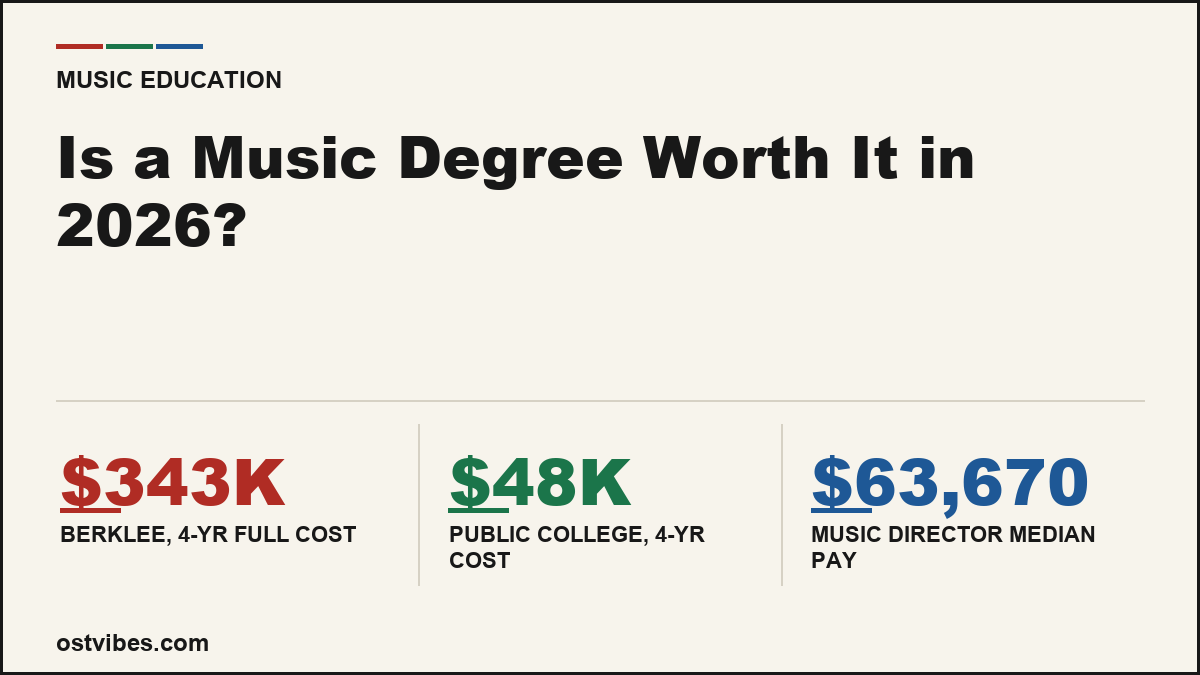
Here is the short answer. Four years of music school costs anywhere from about $48,000 in tuition at an average public in-state college to roughly $343,000 all-in at Berklee. Meanwhile, the median performing arts graduate earns $44,000 a year early in their career — $14,000 less than the median for all college majors.
But averages hide the real story. For music teachers, music therapists, and future professors, the degree is required by law or by hiring rules, and those careers pay steadily. For performers and producers, the government’s own data says no degree is needed at all. This guide walks through the real numbers so you can see which side you are on.
What a music degree costs in 2026
Start with sticker prices. According to the College Board’s Trends in College Pricing 2025, average published tuition and fees for 2025-26 are $11,950 per year at public four-year schools for in-state students, $31,880 for out-of-state students, and $45,000 at private nonprofit colleges. Over four years, that is roughly $47,800, $127,500, and $180,000 — before housing, food, or a new instrument.
You will often hear that “a music degree costs $200K.” That is only true of private schools once living costs are added. A music education degree from your state university is a much smaller bet than the internet suggests.
Top music schools cost far more
Conservatories sit at the top of the range. Berklee’s own 2026-27 cost sheet lists tuition at $54,020, mandatory fees at $1,600, and on-campus room and board at $21,300 — a total estimated cost of attendance of $85,817 per year, or roughly $343,000 over four years at current rates. Juilliard’s 2026-27 student budget totals $91,946 for the nine-month year, though the school notes that more than 90 percent of its students receive scholarship assistance.
Sticker price is not final price. Before you rule out a top program, compare options in our guide to the best music colleges and see what aid exists in our roundup of music scholarships. Aid can change the math completely.
The online and short-course route
Berklee also sells a much cheaper version of itself. Berklee Online’s full accredited bachelor’s degree costs $59,160 for 120 credits — just over a quarter of what four years of on-campus tuition alone would run — and a single 12-week course costs $1,575. The online master’s runs $33,120. If you only need specific skills rather than a credential, our list of the best music courses covers options that cost less than one month of conservatory tuition.
What musicians actually earn
Now the income side. According to BLS data, the median hourly wage for musicians and singers was $42.45 in May 2024. The lowest-paid 10 percent earned under $18.68 per hour, while the top 10 percent earned more than $105.44.
That hourly rate looks healthy, but do not multiply it by a full-time year. It counts only hours actually worked, and most performing work is part-time, seasonal, and gig-based. The newer May 2025 BLS payroll survey shows a median of $47.80 per hour — but that survey covers only 36,180 wage-and-salary jobs and excludes self-employed players, while the broader BLS count shows 169,800 musician jobs in total. A strong hourly rate spread across 15 billable hours a week is still a modest annual income.
Salaried roles are easier to read. Music directors and composers earned a median of $63,670 per year in May 2024, with the bottom 10 percent under $34,990 and the top 10 percent above $157,010.
| Role | Median pay (BLS) | Typical education | Data year |
|---|---|---|---|
| Musicians and singers | $42.45/hour | No formal credential | May 2024 |
| Music directors and composers | $63,670/year | Bachelor’s degree | May 2024 |
| High school teachers | $64,580/year | Bachelor’s + state license | May 2024 |
| Postsecondary teachers | $83,980/year | Usually a Ph.D. | May 2024 |
| All U.S. occupations | $24.51/hour | — | May 2025 |
Where you play matters too. In May 2024, musicians working for religious and civic organizations earned a median of $48.52 per hour, performing arts employers paid $45.74, and educational services paid $30.50.
The real risk is underemployment, not unemployment
Critics of music degrees usually point at unemployment. That is the wrong number. The New York Fed’s labor market data for recent graduates (latest release, based on 2024 data) shows performing arts majors at 7.0 percent unemployment, against 4.2 percent for all majors. Not great, but not a catastrophe.
The bigger gap is underemployment — working a job that does not require your degree. For performing arts majors, it is 63.9 percent, versus 39.4 percent for all majors. Nearly two in three graduates are in work a degree was not needed for. Pay follows the same pattern: a $44,000 median early-career wage versus $58,000 for all majors, and $75,000 versus $87,000 at mid-career. Note that the Fed’s category is performing arts as a whole, not music alone.
The long run softens the picture. The SNAAP alumni survey (2022 data) puts arts and design graduates at a median income of $45,000 three years after graduation, $55,000 at year seven, and $65,000 at year ten — a 44 percent climb, with wide swings early on. Within five years, 61 percent work primarily in arts-related fields, and 81 percent report high career satisfaction regardless of occupation. The honest read: a music degree rarely leads to disaster. It leads to a slower, bumpier earnings path that most graduates still say they are glad they took.
When a music degree clearly pays off
Some music careers are gated by credentials. If one of these is your goal, the degree question answers itself.
Public school music teaching
Public school teachers must hold at least a bachelor’s degree plus a state-issued certification or license. There is no self-taught route into a band room. High school teachers earned a median of $64,580 in May 2024, and even with a slight projected decline, BLS expects about 66,200 openings per year through 2034. Our breakdown of music teacher salary covers what directors and classroom music teachers actually take home by state.
Music therapy
Music therapy is fully degree-gated. The American Music Therapy Association requires a bachelor’s degree or higher from an AMTA-approved program, including 1,200 hours of clinical training with a supervised internship, before you can sit the MT-BC board exam. That credential is necessary to practice and may be required for state licensure. No degree, no career.
College teaching and academia
Postsecondary teachers typically need a Ph.D., though a master’s can be enough at community colleges. The reward is real: a median of $83,980 in May 2024, with employment projected to grow 7 percent through 2034 — much faster than average. Narrowing to the field, postsecondary art, drama, and music teachers averaged $94,700 per year in May 2025, the best-paid music-related line in federal wage data.
Film scoring and music direction
BLS lists a bachelor’s degree as the typical entry credential for music directors and composers. It is a small, flat field — 47,300 jobs in 2024, a projected 0 percent change through 2034, and about 4,300 openings per year — so formal training plus a strong network is the whole game. Performing arts companies pay these roles a median of $75,040. If scoring for film and games is the dream, a degree buys orchestration training and contacts; our soundtrack guides cover how the industry side actually works.
When skipping the degree wins
For performers, BLS is blunt: the typical entry-level education for musicians and singers is “no formal educational credential.” The listed path is long-term on-the-job training. In plain terms — practice, gigs, and repetition.
In performance, production, songwriting, and session work, nobody checks for a diploma. They check what you have released and who you have played with. A $1,575 online course that fixes one specific weakness can beat a $54,020 tuition year that does not. Stack a few targeted courses, release constantly, and you have spent under $10,000 where a conservatory student spent six figures.
The business skills that decide whether music pays you are also mostly learned outside universities: how streaming royalties work (start with our Spotify per-stream breakdown), how to get songs on platforms (see our distribution comparison), registering with a performing rights organization (our ASCAP vs BMI vs SESAC guide explains the differences), and sync licensing — placing songs in ads, games, and TV.
Adjacent technical roles reward skills over paper too. Sound engineering technicians averaged $81,390 per year in May 2025 (median $35.16 per hour), and many enter through certificates or two-year programs rather than four-year degrees.
Frequently Asked Questions
How much does a music degree cost in total?
At 2025-26 average published prices, four years of tuition and fees run about $47,800 at a public in-state school, $127,500 out-of-state, and $180,000 at a private nonprofit — before room and board. Top conservatories list full annual costs of attendance of $85,817 (Berklee) to $91,946 (Juilliard) for 2026-27, though most students receive aid. Berklee Online’s complete bachelor’s is $59,160.
Do you need a degree to be a professional musician?
No. BLS lists “no formal educational credential” as the typical entry requirement for musicians and singers, with long-term on-the-job training as the pathway. A degree can sharpen your theory, ensemble experience, and network, but hiring in performance is driven by your portfolio and reputation, not your transcript.
Which music careers actually require a degree?
Three are hard-gated: public school music teaching (bachelor’s plus a state license), music therapy (an AMTA-approved degree, 1,200 clinical hours, and board certification), and college teaching (usually a Ph.D.). Music direction and composition are softer cases — BLS lists a bachelor’s as the typical entry credential, but there is no legal requirement.
What is the best-paid music career in government data?
Postsecondary art, drama, and music teachers, who averaged $94,700 per year in May 2025 — a job that normally requires a doctorate. Among non-academic roles, the top 10 percent of music directors and composers earned over $157,010 in May 2024, and the top 10 percent of musicians and singers earned more than $105.44 per hour.
The bottom line
A music degree is worth it in 2026 if you want a credential-gated career: public school teaching, music therapy, or academia — and, more loosely, music direction and composition. Those paths pay medians of roughly $63,670 to $83,980, reach a $94,700 average in college music teaching, and simply cannot be entered without the paper.
It is a weak financial bet if your goal is performing, producing, or releasing your own music. The government says no credential is required, performing arts majors face 63.9 percent underemployment, and a $59,160 online degree or a handful of $1,575 courses buys the same skills for far less. Spend the difference on gear, recordings, and touring — then learn how the money actually moves through the industry with our music business guides.

Riya has spent six years writing about music. At OST Vibes she covers soundtracks for film, series and games — who scored what, what is actually on each official release, and where to listen to it. Her focus is English-language pop and screen music. Spot a mistake in a tracklist or a credit? Email [email protected] and it will be corrected.