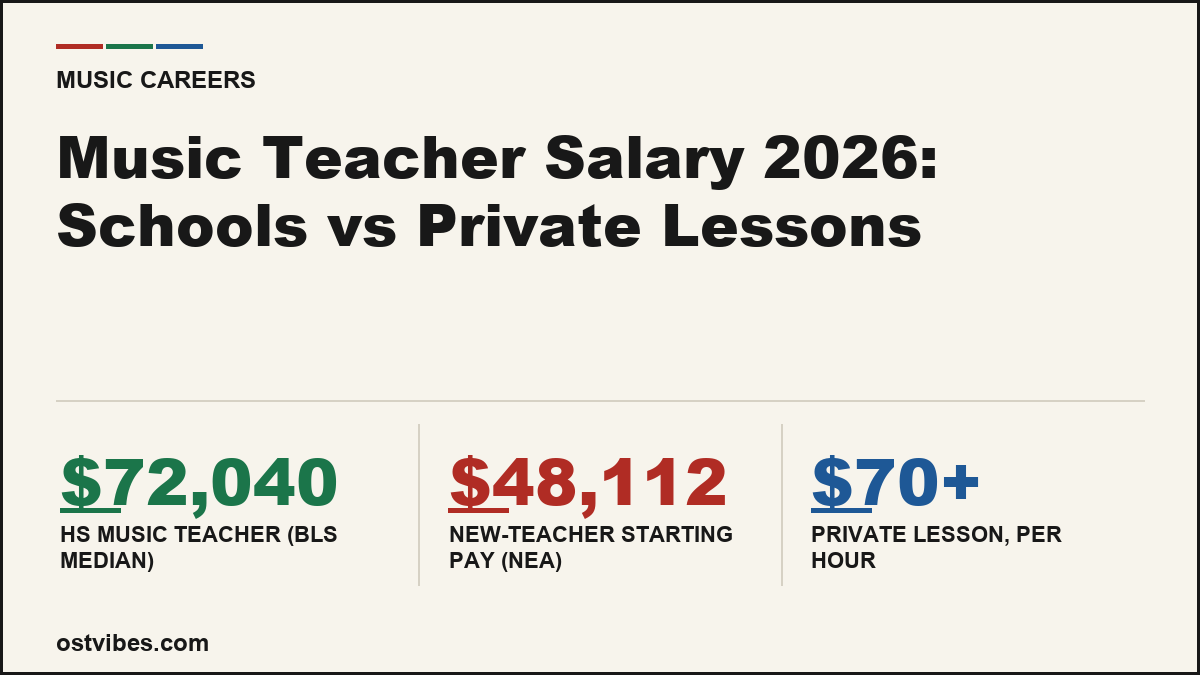
A full-time public school teacher in the United States earned an average of $74,495 in the 2024-25 school year, according to the National Education Association. School music teachers sit on that same pay scale. Private lesson teachers, meanwhile, charge $70 to $100 for a one-hour lesson in 2026.
So which path pays more? Schools win the year. Private lessons win the hour, at least on paper. The median self-employed instructor actually takes home about $46,800 a year, well below a typical school salary. Here is the full breakdown, using the latest government and industry data.
The short answer, in one table
First, a quick note on the data. The Bureau of Labor Statistics (BLS) does not track “K-12 music teacher” as a separate job. School music teachers are paid on the same district salary schedule as math and English teachers, so general teacher data is the best official guide. Private instructors fall under a BLS category called “self-enrichment teachers,” which covers people who teach skills for personal enjoyment rather than school credit. That category is the closest official measure of what private music teachers really earn.
| Teaching path | Pay | What it measures |
|---|---|---|
| Elementary school teacher | $63,970/year | Median salary (BLS OEWS, May 2025) |
| Middle school teacher | $64,370/year | Median salary (BLS OEWS, May 2025) |
| High school teacher | $72,040/year | Median salary (BLS OEWS, May 2025) |
| All public school teachers | $74,495/year | National average, 2024-25 (NEA) |
| New public school teachers | $48,112/year | Average starting salary, 2024-25 (NEA) |
| Private lessons, gross rate | $70-$100/hour | Advertised 60-minute lesson price (Ensemble Schools, 2026) |
| Self-enrichment teachers | $22.50/hour ($46,800/year) | Median actual earnings (BLS OEWS, May 2025) |
| Music teacher, all settings | $54,498/year | Aggregator estimate (ZipRecruiter, July 2026) |
One caution on that last row. The ZipRecruiter figure is a model estimate built from job postings, not official government data. It blends full-time school positions with part-time and private work, which is why it lands below the BLS and NEA school numbers. ZipRecruiter’s estimated range runs from $20,000 up to $84,500, which mostly shows how scattered music teaching pay is. Treat it as a rough midpoint across every kind of music teaching, not as a salary you should expect.
What school music teachers earn in 2026
The national numbers
The freshest official wage data comes from the BLS Occupational Employment and Wage Statistics survey, released for May 2025. It shows a median salary of $72,040 for high school teachers. The median is the middle value: half earn more, half earn less. Elementary teachers had a median of $63,970, and middle school teachers $64,370.
The spread around that median is wide. Entry-level teachers cluster well below it, while veteran teachers with decades of service and advanced degrees can clear six figures in high-cost states. Most districts pay on a fixed step schedule, so your salary climbs with years of service and extra credentials, such as a master’s degree.
A quick note on dates, because you will see conflicting figures online. The BLS career handbook page still shows the older May 2024 median of $64,580 for high school teachers, while the newer May 2025 survey shows $72,040. Both are real BLS numbers; the survey figure is simply a year fresher. This article cites the May 2025 data throughout.
The NEA’s April 2026 report tells the same story from the union side. The national average teacher salary reached $74,495 in 2024-25, a 3.5% raise from $71,985 the year before. Starting pay is far lower: the average first-year teacher earned $48,112.
The salary is only part of the package. School jobs usually include employer-paid health insurance, a pension, and paid sick leave. BLS also notes that most teachers do not teach during the summer, unlike a job that runs 12 months a year. That break is exactly when private lesson demand from families stays open for a side income.
The best and worst paying states
Location changes the math more than anything else. NEA data puts California on top with an average teacher salary of $103,552, followed by New York at $98,655 and Washington at $96,589. At the bottom sit Mississippi at $54,975, Florida at $56,663, and Louisiana at $56,785.
Starting salaries follow the same pattern. Washington, D.C. pays new teachers the most, at $64,640 on average, while Montana pays the least, at $36,682. Same job, same certification, tens of thousands of dollars apart depending on which side of a state line you teach.
What private music lessons pay per hour
Private lesson pricing is remarkably consistent across sources in 2026. Ensemble Schools’ current cost guide puts a 30-minute lesson at $35 to $50 and a 60-minute lesson at $70 to $100. A student taking weekly half-hour lessons pays about $170 per month, and weekly hour-long lessons average around $320 per month. The Sloan School of Music lists nearly identical ranges: $30 to $50 for an introductory half hour and $65 to $100 for a full hour.
Online is not the discount option many students expect. Ensemble Schools reports that most teachers keep the same price for online and in-person lessons. Lesson With You, an online lesson company, prices online piano lessons at $30 to $40 per half hour, with in-person lessons running somewhat higher per session.
Where you land inside those ranges depends on your credentials, your instrument, and your city. Teachers with degrees, teaching experience, and performance credits price near the top. Beginners and student teachers price near the bottom.
Some teachers grow past their own calendar entirely, hiring other instructors and renting a dedicated space. At that point you are running a music school, not a lesson schedule, and financing becomes the next hurdle. Our guide to getting a business loan for your music studio covers that step.
Why $80 an hour becomes $46,800 a year
Now the part most rate guides skip. The BLS tracks private instructors as self-enrichment teachers, and the May 2025 figures are sobering: a median wage of $22.50 per hour and median annual earnings of $46,800 across 332,110 workers. The mean, or simple average, is only slightly better at $26.32 per hour, or $54,740 per year.
How does a $70 to $100 lesson rate collapse to $22.50 an hour? Because the lesson rate only pays for minutes spent teaching. Everything else is unpaid:
- Scheduling, invoicing, and chasing late payments
- Lesson planning and learning each student’s repertoire
- Travel between students’ homes if you teach in person
- Marketing yourself to replace students who quit
- Cancellations, holidays, and the summer slowdown
Self-employed teachers also buy what school districts provide for free. There is no employer health plan and no pension. There is also self-employment tax: employees split Social Security and Medicare taxes with their employer, while a self-employed teacher pays both halves. Run the arithmetic on 20 billable hours a week at $80. It looks like $1,600, but add ten unpaid admin hours, then subtract taxes, insurance, and studio costs, and the effective hourly rate drops fast.
This is why successful private teachers run their studios like businesses and stack income streams. Many perform, record, or write on the side. If you release your own music, learn what Spotify actually pays per stream and how sync licensing can turn your recordings into extra income.
Online teaching platforms in 2026
Online platforms solve the hardest private-teaching problem, finding students, in exchange for a cut of your rate. Here is how the major ones pay in 2026.
Lessonface
Lessonface is a live marketplace where teachers set their own rates. The average lesson price is about $38, with 30 minutes as the standard booking, and listed teachers charging roughly $24 to $37 per half hour. The platform takes a 15% commission on students who find you through Lessonface, but only 5% on students you recruit yourself. Pay is guaranteed for booked lessons, which removes the no-show risk that plagues independent teaching.
Musika
Musika works as a referral service. You state your rate and receive 100% of it by direct deposit. Musika then adds its own markup on top of your rate, and that markup, paid by the student, is the company’s revenue. Teachers work as 1099 independent contractors, which means no taxes are withheld and you handle your own quarterly payments to the IRS.
The TakeLessons warning
TakeLessons no longer exists. Microsoft bought the platform in 2021 and later shut it down, and Microsoft’s official closure FAQ confirms all accounts became inaccessible on November 15, 2024. Plenty of older articles still quote TakeLessons rates as if the platform were live. Ignore them. Any pricing tied to TakeLessons is dead data.
You can also skip platforms entirely and teach over video call on your own. You keep 100% of your rate, but you also do 100% of the marketing, and the self-enrichment earnings data above shows how hard that part is.
What it costs to enter each path
The school path has a gate. Public school teachers need at least a bachelor’s degree plus a state-issued teaching certificate or license, according to the BLS Occupational Outlook Handbook. For music, the standard content exam is the Praxis Music: Content Knowledge test (5113) from ETS: it costs $130 and packs 120 questions into two hours, including 30 questions based on recorded musical excerpts. It is required in many states, with passing scores set state by state.
That gate costs years and tuition, which raises a fair question before you commit: whether a music degree is worth the investment, how to pick the right music program, and how scholarships can cut the cost sharply. If a full degree is off the table, targeted music courses can still build real teaching credibility.
One more caution about the classroom: the same BLS handbook projects employment of high school teachers to decline 2% from 2024 to 2034, a loss of about 17,800 jobs. A school position is stable once you hold one, but the overall pool is shrinking slightly, not growing.
The private path has almost no gate. No license is required to teach lessons. Your startup costs are business costs: an instrument, a teaching space, liability insurance, a booking system, a simple website. You can start next week. You just start without a safety net.
Frequently Asked Questions
Do private music teachers make more than school music teachers?
Per hour, private teachers gross more: $70 to $100 for an hour-long lesson beats the hourly equivalent of most teaching salaries. Per year, school teachers usually win. The median self-enrichment teacher earns $46,800, while school teacher medians run $63,970 to $72,040 and the NEA average is $74,495, with health insurance and a pension on top.
How much should I charge for private lessons in 2026?
Market rates are $35 to $50 for 30 minutes and $70 to $100 for an hour. Price by your credentials and your city, not by guilt. And charge the same online as in person: industry guides confirm most established teachers keep one price across both formats.
Do I need a degree to teach music?
Not for private lessons; students care about results and reputation. Public schools are different. You need a bachelor’s degree, state certification, and in many states a passing score on the $130 Praxis 5113 exam. A degree also helps you charge near the top of the private range, so it strengthens both paths.
Are music teaching jobs growing?
Not in schools. The BLS projects a 2% decline in high school teaching jobs from 2024 to 2034. The private side employs 332,110 self-enrichment teachers, and demand there follows family budgets rather than school funding. Most working music teachers hedge by combining several income streams instead of betting everything on one.
The bottom line
Choose the school path if you want the higher, more predictable annual income: a $74,495 national average, benefits, a pension, and summers free for gigging or private students. Choose the private path if you want control over your rate and your calendar, and treat it as a business from day one. The gap between $100 an hour and $46,800 a year is made of unpaid admin hours, cancellations, and missing benefits.
The strongest position is often both: a certified school job for the salary and benefits, plus a small private studio on evenings and summers at $70 to $100 an hour. For more on the money side of a music career, browse our music business guides.
Riya has spent six years writing about music. At OST Vibes she covers soundtracks for film, series and games — who scored what, what is actually on each official release, and where to listen to it. Her focus is English-language pop and screen music. Spot a mistake in a tracklist or a credit? Email [email protected] and it will be corrected.