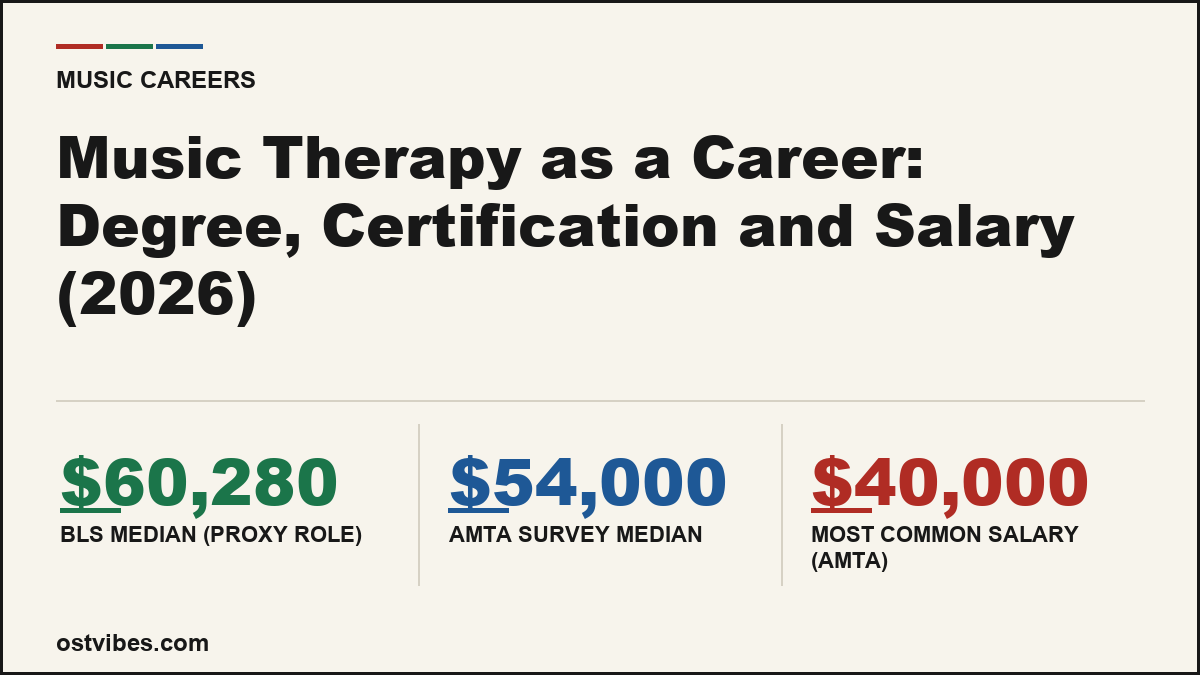
A board-certified music therapist in the United States earns somewhere between $54,000 and $60,000 a year, depending on which dataset you trust. There is no single official government number for this exact job title, so every salary figure you see is either a proxy, a member survey, or an aggregator estimate — and this article tells you which is which.
Getting the credential behind that paycheck takes real work. You need a bachelor’s degree from one of the roughly 80 schools approved by the American Music Therapy Association (AMTA), 1,200 hours of supervised clinical training, and a passing score on a national board exam that only about half of all test-takers clear on any given attempt. Here is what the degree, the exam, and the pay actually look like in 2026.
What Music Therapists Actually Do
Music therapy is a clinical health profession, not background music piped into a hospital room. A board-certified music therapist — the credential is written MT-BC — assesses a patient’s needs, then uses music as a tool to reach a goal that has nothing to do with music itself. That might mean singing exercises to rebuild speech after a stroke, rhythmic movement to improve gait after surgery, songwriting to process grief in hospice care, or structured listening to calm a child’s sensory system.
AMTA describes the profession as reaching far beyond hospitals. Music therapists work in psychiatric hospitals, community mental health agencies, rehabilitation centers, nursing homes, schools, and private practice, with growing demand in hospice care, oncology units, substance-abuse programs, pain management clinics, and correctional facilities. It is a treatment role, built on assessment, documented goals, and measurable outcomes — closer to occupational therapy or speech-language pathology than to performing.
How Much Do Music Therapists Make in 2026?
Start with the honest caveat: the U.S. Bureau of Labor Statistics does not track “music therapist” as its own job. The MT-BC credential is folded into the Recreational Therapists occupational code, which is the closest official government proxy for music therapy pay. Under that code, the median annual wage was $60,280 in May 2024, with the bottom 10% of earners making under roughly $39,520 a year and the top 10% making over roughly $96,600.
AMTA’s own membership survey tells a slightly different story, because it captures music therapists specifically rather than the broader recreational-therapy field. In its most recently published Workforce Analysis, the median full-time salary was $54,000, though the single most common salary reported was $40,000 — a reminder that entry-level pay sits well below the median for years in this field. A newer AMTA survey exists, but it is not free to the public; it is a member benefit or a $65 purchase, so the 2021 figures remain the most recent openly citable numbers.
Salary aggregators fill in the gap between those two anchors, and they should be read as estimates, not measured pay. ZipRecruiter puts the average at $56,893, PayScale at $51,784, and Salary.com at $66,971. Glassdoor’s figure of $87,010 sits well above every other source found for this article — treat it as an outlier rather than a realistic baseline.
| Source | Reported Figure | What It Measures |
|---|---|---|
| BLS (Recreational Therapists proxy) | $60,280/year (median) | Government wage data, May 2024 |
| AMTA 2021 Workforce Survey | $54,000/year (median); $40,000 most common | Member-reported salary survey |
| ZipRecruiter | $56,893/year (average) | Aggregator estimate, 2026 |
| PayScale | $51,784/year (average) | Aggregator estimate, 2026 |
| Salary.com | $66,971/year (average) | Aggregator estimate, 2026 |
| Glassdoor | $87,010/year (average) | Aggregator estimate — likely outlier |
Pay by Work Setting
Where you work changes what you earn. BLS industry-level data for the Recreational Therapists code shows psychiatric and substance-abuse hospitals as the highest-paying setting, with a mean wage around $64,060 a year and roughly 3,420 jobs in that category. General medical and surgical hospitals follow closely, averaging around $62,750 a year across about 2,650 jobs. Nursing care and skilled nursing facilities employ a large share of the workforce too — about 2,040 jobs — but pay less on average, around $49,800 a year. School and private-practice pay varies widely and is not broken out separately in this dataset, but tends to track closer to the lower end of the range, especially for therapists paid hourly or per session.
If you are weighing music therapy against a related classroom-based career, it is worth comparing notes with what music teachers earn — a different credential path with its own pay ceiling and school-district structure.
The MT-BC Certification Path (CBMT)
The Certification Board for Music Therapists (CBMT) issues the MT-BC credential, and it is not optional — nearly every job posting in the field requires it. To even sit for the exam, a candidate must first complete the academic and clinical training requirements set by AMTA, according to CBMT’s own examination page. You can apply before finishing your internship, but you cannot schedule or sit the actual exam until the internship and all degree requirements are done.
The exam itself is 150 multiple-choice questions, though only 130 of them are scored — the other 20 are unscored “pretest” questions CBMT is quietly testing for future exams. The current passing point is 97 correct out of those 130 scored questions. It is delivered by computer at more than 200 PSI testing centers in the US and abroad, and there are no application deadlines; you apply whenever you meet the eligibility requirements. First-time candidates pay $325 (a $275 exam fee plus a $50 processing fee); retake candidates pay $275. Candidates who trained outside the US or Canada go through a separate equivalency process.
The exam is genuinely difficult. CBMT’s latest published statistics show a 68% first-time pass rate and a 51% pass rate overall across all attempts. As of the most recent count, 10,699 people hold the MT-BC credential nationwide, with 675 newly certified in 2025. That growth has slowed sharply — the field grew about 7% a year back in 2014, compared to roughly 2% in 2025 — which tracks with a profession that has matured rather than one that is exploding in size, according to CBMT’s certificant data.
Passing the exam is not the end. The MT-BC credential is valid for five years, and renewing it means accruing 100 continuing-education credits, paying an annual maintenance fee, and filing a recertification application. If you want a head start on those continuing-education hours, browsing music courses built for career advancement is a reasonable place to look before you even graduate.
AMTA-Approved Degree Requirements
You cannot back into this profession with just any music degree. AMTA requires a bachelor’s degree or higher in music therapy specifically, earned from one of more than 80 AMTA-approved college and university programs. If you are still choosing a school, it is worth reading a broader comparison of the best music colleges alongside AMTA’s approved list, since not every strong music school offers an approved music therapy track — and a program that is not approved will not make you eligible for the CBMT exam at all.
The curriculum is built around three areas: musical foundations, clinical foundations, and music therapy foundations and principles. AMTA’s published education standards break a roughly 120-semester-hour bachelor’s degree down approximately like this: musical foundations make up about 45% of coursework, general education 20-25%, clinical foundations 15%, music therapy coursework itself 15%, and electives fill the remaining 5%. That musical-foundations weighting surprises some prospective students — this is still, at its core, a music degree with a clinical layer built on top, not the other way around.
Clinical training is where the degree gets serious. AMTA requires a minimum of 1,200 clinical hours, split into at least 180 hours (15%) of pre-internship fieldwork and at least 900 hours (75%) of supervised internship. A credentialed music therapist has to personally observe students for at least 40% of pre-internship sessions. Students also need a C- or better in every foundational music therapy course before they are allowed to start their internship — there is no squeaking through on a lower grade and hoping to catch up later.
If you already hold a bachelor’s degree in something else, you are not locked out. AMTA-approved “equivalency” programs let you earn the equivalent of a music therapy bachelor’s degree, built around the same 1,200-hour clinical requirement, without starting a second four-year degree from scratch. Master’s programs exist too, aimed at “advanced competencies” beyond entry-level training, though AMTA has historically had less formal structure around doctoral-level delineation than it does at the bachelor’s and master’s levels. Before committing years and tuition to any of this, it is worth stepping back and asking the broader question of whether a music degree is worth it for your specific goals — music therapy is one of the few paths in music where the answer tends to be a clearer yes, precisely because the credential gates entry to the job.
Where Music Therapists Work
Hospitals and senior care make up the biggest visible chunk of the field, but the full list of settings is broader than most people expect:
- General and psychiatric hospitals
- Community mental health agencies
- Rehabilitation centers and nursing homes
- K-12 schools and special-education programs
- Hospice and palliative care
- Substance-abuse treatment programs
- Oncology treatment centers and pain-management clinics
- Correctional facilities
- Private practice
Private practice deserves a separate note, because it is the one setting where a music therapist becomes a small business owner rather than an employee. That means billing, scheduling, insurance paperwork, and sometimes renting or building out a therapy space — the same practical hurdles any solo practitioner faces. If you go that route and need to fund equipment or a studio space, the same financing options covered in our guide to getting a business loan for a music studio apply just as well to a therapy practice as to a recording studio.
Licensure adds another wrinkle depending on where you practice. CBMT currently lists 20 US states and jurisdictions with some form of music therapy regulation — a license, title protection, a registry, or state certification. Mississippi added a law in June 2025, joining Washington, Ohio, Connecticut (all 2023), and Illinois (2022) among recent additions. If you plan to practice in a regulated state, check CBMT’s state requirements page before committing to a program, since state rules can affect what your degree and internship need to look like.
Music Therapy vs. Other Music Careers
Music therapy is a clinical path, not a performance or royalty path, and it is worth being clear-eyed about that difference before you commit four-plus years to it. If your interest in music careers is broader than clinical work, there are entirely different income models to weigh — royalties from streaming platforms (see how much Spotify actually pays per stream), getting your catalog onto services through the right music distribution service, placing songs in film and TV through sync licensing, or collecting performance royalties through a performing rights organization — a choice we break down in ASCAP vs. BMI vs. SESAC.
None of those paths require a licensing exam or a clinical internship, but none of them come with music therapy’s steady, credentialed job market either. For more career and business breakdowns across the music industry, our music business hub covers both sides of that trade-off.
Frequently Asked Questions
Do you need a master’s degree to become a music therapist?
No. A bachelor’s degree from an AMTA-approved program (or an approved equivalency program if your first degree was in something else) is enough to sit for the CBMT exam and start practicing as an MT-BC. Master’s programs exist for therapists who want advanced competencies beyond entry-level training, often useful for supervisory, research, or academic roles, but they are not required to enter the field.
Is the CBMT exam hard to pass?
Yes, relative to many licensing exams. CBMT’s own data shows a 68% first-time pass rate and a 51% pass rate across all attempts combined, meaning roughly half of everyone who has ever sat for it, including repeat attempts, has not passed. The exam covers 150 questions, with 130 scored, and you need 97 correct to pass.
Which states require a music therapy license?
CBMT currently lists 20 US states and jurisdictions with some form of music therapy regulation, ranging from full licensure to title protection or a state registry. The list has grown recently, with Mississippi, Washington, Ohio, Connecticut, and Illinois all adding requirements since 2022. Regulation status can change, so check with CBMT or your state’s health licensing board before assuming your MT-BC credential alone is sufficient to practice in a given state.
Can you become a music therapist without a music therapy degree?
Not through the standard route, but there is a documented workaround. If you already hold a bachelor’s degree in a different field, AMTA-approved equivalency programs let you complete the same 1,200 hours of clinical training and coursework needed to become CBMT-eligible, without repeating a full four-year degree. Musical skill alone, without one of these formal pathways, will not qualify you to sit for the board exam.
The bottom line
Music therapy pays a median somewhere around $54,000 to $60,280 a year depending on whether you trust AMTA’s own survey or the government’s closest proxy, with real upside in psychiatric and general hospitals and less upside in nursing facilities and schools. The credential is not optional and not easy — a bachelor’s degree from an approved program, 1,200 clinical hours, and a board exam that half of all candidates fail. What you get in return is a real license to practice, steady demand across hospitals, schools, and senior care, and a job market that has matured into a stable, if not explosive, allied health field.

Riya has spent six years writing about music. At OST Vibes she covers soundtracks for film, series and games — who scored what, what is actually on each official release, and where to listen to it. Her focus is English-language pop and screen music. Spot a mistake in a tracklist or a credit? Email [email protected] and it will be corrected.