
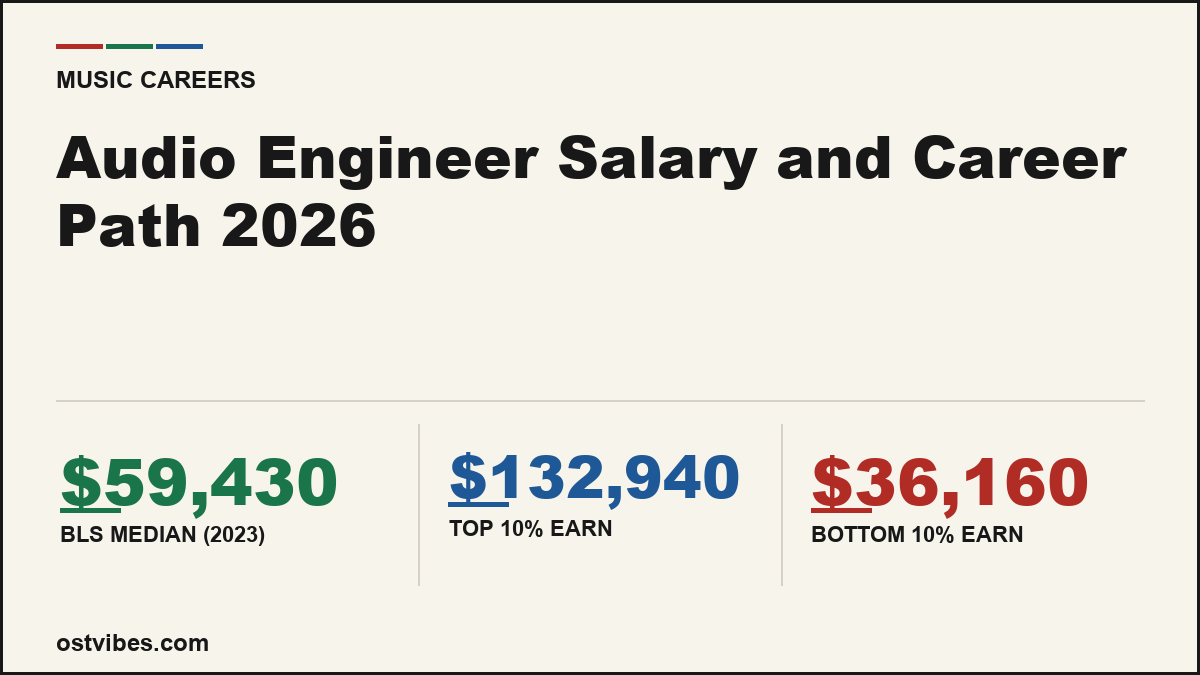
Sound engineering technicians earned a median of $59,430 a year in 2023, according to the Bureau of Labor Statistics’ occupation-specific wage data for the role (SOC code 27-4014). A newer estimate, based on 2025 BLS figures, puts the median closer to $73,130. Neither number tells you what you’ll actually make, though, because pay in this field splits hard by setting: a network broadcast engineer, a touring front-of-house mixer, and a freelance podcast editor are all “audio engineers” on paper and worlds apart on a pay stub.
This guide covers what the government data actually says, how pay compares across studio, live, broadcast, and post-production work, how people really get hired without a four-year degree, and what freelance engineers charge per day in 2026.
What Sound Engineering Technicians Actually Earn in 2026
BLS tracks this job two ways, and the numbers don’t match — which trips people up searching “audio engineer salary.”
The narrow, occupation-specific number comes from BLS’s Occupational Employment and Wage Statistics program for SOC 27-4014, Sound Engineering Technicians. In the most recent year BLS published a standalone data page for this title, median pay was $59,430 a year, or $28.57 an hour, with a mean of $74,100. About 14,600 people held this job title nationally.
The broader number comes from the public-facing BLS Occupational Outlook Handbook, which folds sound engineers into a wider group, “Broadcast, Sound, and Video Technicians,” that also includes audio/video equipment techs, broadcast techs, and lighting techs. That group reported a lower median of $56,600 a year ($27.21/hour) in May 2024, across 146,100 jobs. Useful for context, but not a pure read on audio engineering pay.
Here’s how pay spreads out for the occupation-specific title:
| Percentile | Annual Wage |
|---|---|
| 10th percentile | $36,160 |
| 25th percentile | $45,820 |
| 50th percentile (median) | $59,430 |
| 75th percentile | $94,550 |
| 90th percentile | $132,940 |
Source: BLS OEWS, May 2023, SOC 27-4014. That 3.7x jump from the 10th to the 90th percentile is the real story. Where you land depends almost entirely on industry, location, and seniority — not the job title on your card.
For a more current snapshot, O*NET OnLine, a Department of Labor-sponsored database, cites 2025 BLS wage data putting sound engineering technicians at a median of $73,130 a year ($35.16/hour), with about 16,900 people employed as of 2024. See the full breakdown at O*NET’s occupation profile.
The job-growth picture is where the two sources disagree. The broader Handbook category projects 1% growth from 2024 to 2034, with roughly 11,100 openings a year, mostly from people leaving the field. O*NET’s occupation-specific projection for sound engineering technicians is a decline of -1% or worse over the same decade, with only about 1,200 total openings across all ten years. Likely explanation: the broader category is propped up by growth in video and broadcast-adjacent roles, while the narrower console-engineer job may be shrinking as fewer people handle more output with better tools.
Studio vs. Live vs. Broadcast vs. Post-Production Pay
BLS’s industry breakdown for sound engineering technicians is the most reliable comparison across settings, since it’s drawn from payroll data rather than self-reported submissions. As of May 2023: Motion Picture and Video Industries employed 3,980 sound engineers at a mean of $99,990 — the strongest number in the data. Sound Recording Industries (traditional music studios) employed 2,400 at a mean of $59,040. Radio and Television Broadcasting Stations employed 650 at a mean of $59,590. Promoters of Performing Arts, Sports, and Similar Events, the closest BLS category to live-sound touring and venue work, employed 770 at a mean of $57,300.
The highest-paying industry was Software Publishers, at a mean of $128,470 — game audio, not a traditional studio job. California had the most sound engineers of any state (6,060 workers, mean $83,340), followed by New York (1,460 workers, mean $89,450).
Live sound: read aggregator numbers with caution
Salary aggregators disagree wildly on live sound pay. ZipRecruiter’s self-reported estimate for “Live Sound Engineering” puts the national average at $146,868 a year, while Salary.com’s estimate for the near-identical title “Live Sound Engineer” puts it at $51,099 — less than a third as much. Both are aggregator estimates built from job postings and user submissions, not payroll surveys, and a gap that large means neither should be treated as a solid number. BLS’s closest matching industry (event promoters, $57,300 mean) sits much closer to the Salary.com estimate.
Broadcast: certification moves the needle
ZipRecruiter’s estimate for “Broadcast Engineer” is $86,597 a year on average. A more grounded number comes from the Society of Broadcast Engineers’ 2025 member survey: radio engineers holding SBE certification averaged about $88,000 a year, versus about $80,000 for those without it — an $8,000 gap tied to credentialing. Combined radio-and-television engineers showed an even wider gap, around $20,000, according to Radio World’s coverage of the SBE survey. In broadcast, certification is one of the few concrete levers that moves pay.
Post-production: wide range depending on what you cut
Salary.com’s estimate for “Audio Post Production” work sits at $46,255 a year, blending podcast editing and corporate video with feature and broadcast deliverables. The BLS motion-picture figure above ($99,990 mean) is a better proxy for engineers on scripted TV and film, where union scale and bigger budgets apply. Mixers who also handle deliverables for trailers and ads should understand how sync licensing works, since it affects what formats clients expect. For film and TV work, our soundtrack coverage is worth a look for how composer pay compares.
How People Actually Break In: Runner Path vs. Film School
This job doesn’t require a degree the way accounting does. O*NET’s survey of employers found only 20% required a bachelor’s degree for new hires; 32% said a high school diploma was enough, and another 20% required a post-secondary certificate instead. The occupation is rated “Job Zone Three: Medium Preparation Needed” — vocational training, on-the-job experience, or an associate’s degree, not a four-year program. The Department of Labor also lists “Recording Engineer” and “Sound Mixer” as approved Registered Apprenticeship titles, a paid alternative most people never hear about.
The path that actually works, and the one most working engineers describe, is intern or runner first. Berklee College of Music’s own career page for the assistant engineer role is blunt: wages in that entry job are low, competition for the seats “can be fierce,” and most people spend one to five years as an assistant before moving up to full engineer, going freelance, specializing in mixing or mastering, or moving into studio management. You get in the room, learn the gear, and build the relationships that eventually book you work — no transcript required.
One caution: “unpaid intern” and “runner” aren’t automatically legal categories. The Massachusetts Attorney General’s office cited a Boston recording studio, Bristol Studios, more than $400,000 in restitution and penalties after finding more than 60 unpaid interns doing administrative, promotional, and cleaning work that didn’t qualify as exempt vocational training. That case is from 2021 — a warning, not a current statistic — but a reminder that “we don’t pay runners” is often a labor-law violation, not just an industry norm.
If you’re weighing formal training against jumping straight into runner work, our breakdown of the best music courses for advancing your career covers both routes. And if you’re deciding between the engineering track and a production-focused career, compare against our music producer salary guide — the two paths overlap more than people expect a few years in.
Freelance Day Rates: What the Numbers Really Show
There’s no single trustworthy “freelance audio engineer day rate” — the range spans amateur club gigs to union film sets. The strongest anchor is union scale. IATSE Local 695, the production-sound union for film and television, sets its Production Mixer (journeyperson) rate for August 2025–August 2026 at $100.06 an hour or $900.54 a day, with an 8-hour minimum. Entry-level Production Mixer scale is $86.75 an hour or $780.75 a day, and Boom Operator journeyperson scale is $77.70 an hour or $699.30 a day, per a reproduction of the IATSE Local 695 wage schedule — a negotiated number, not an estimate, and the strongest data point available for professional-tier freelance work.
Outside union work, rates get looser. SideStackers, a freelance-marketplace rate guide (not a statistical survey), publishes illustrative 2026 ranges: a lead or A1 live-sound engineer at $500–$800 a day, an assistant or A2 at $300–$500 a day, corporate A/V work at $650 or more a day, and small music-venue mixing around $200 a night — what the guide calls a “passion wage.” Its hourly ranges run junior $35/hour, mid-level $70/hour, senior $120 or more. Twine’s 2025 rate article, another marketplace resource, estimates studio recording at $25–$300+ an hour, live events at $20–$250+ an hour, and day rates of $300–$1,000 or more, citing a Glassdoor estimate of roughly $52,000 a year for average freelance income, with top earners over $100,000.
ZipRecruiter’s estimate for “Freelance Audio Engineer” lands at $84,456 a year, or $40.60 an hour — one more aggregator estimate, not a settled figure. Rates vary by specialization and union status as much as by skill. A non-union club mixer and a Local 695 production mixer do very different jobs, even under the same title.
- Union film/TV production mixer (journeyperson): roughly $780–$900 per day, per IATSE Local 695 scale
- Lead live-sound engineer (non-union, illustrative): roughly $500–$800 per day, per SideStackers
- Assistant/A2 live sound (non-union, illustrative): roughly $300–$500 per day, per SideStackers
- Club/small-venue mixing: around $200 a night, described by SideStackers as a “passion wage”
Is a Recording Arts Degree Worth the Cost?
Given that only one in five employers surveyed by O*NET say a bachelor’s degree is required, the math on a full audio program deserves scrutiny. Full Sail University’s current tuition page lists its Recording Arts bachelor’s degree at $92,000 total (billed across three years), and its Music Production bachelor’s degree at the same $92,000. Its standalone Audio Arts Undergraduate Certificate, a cheaper alternative, totals $10,500.
Compare that to the runner path: near-zero tuition, but also near-zero pay for the one to five years Berklee describes as typical before you’re earning full engineer money. Neither route is free — a degree costs cash up front, while the runner path costs years of low income and, per the Massachusetts case above, sometimes gets structured illegally. A middle path — a shorter certificate plus low-paid studio time to build a reel — is what a lot of working engineers actually did, and it matches the “Job Zone Three” reality of this field: vocational training or an associate’s degree, not necessarily four years and $92,000.
The eventual ceiling for many engineers is opening their own room instead of renting someone else’s. If that’s the plan, our guide to financing a music studio covers what that actually costs to set up. For the business side of an engineering career more broadly — contracts, royalties, and revenue beyond the day rate — our music business section is a good next stop. It’s also worth comparing this career ladder against adjacent roles, like the one mapped out in our music director salary guide.
Frequently Asked Questions
What is the actual median salary for an audio engineer?
Using BLS’s most detailed occupation-specific data (SOC 27-4014, Sound Engineering Technicians), the median was $59,430 a year in 2023, with a mean of $74,100. Newer O*NET figures citing 2025 BLS data put the median closer to $73,130. Pay varies widely by industry: motion picture and video work averages near $100,000, while music studios and broadcast stations average closer to $59,000.
How much do entry-level or assistant engineers make?
Low, by design. PayScale’s data on “Engineer, Music Recording” roles shows an entry-level average of $17.50 an hour (based on a small sample), and Berklee’s own career page describes assistant-engineer pay as low across the board, with most people staying in that role one to five years before moving up. The trade-off is access: assistant jobs are how you get into the room and build the relationships that lead to better-paying work later.
Is the audio engineering job market growing or shrinking?
Depends which BLS number you use. The broader “Broadcast, Sound, and Video Technicians” category is projected to grow 1% from 2024 to 2034, with about 11,100 openings a year, mostly from replacing people who leave. But O*NET’s occupation-specific projection for sound engineering technicians alone is a decline of -1% or worse over the same period, with only about 1,200 total openings across the whole decade. The narrower number is the more relevant one for audio engineering specifically.
Do I need a college degree to become an audio engineer?
No, not according to the people actually hiring. O*NET’s employer survey found only 20% require a bachelor’s degree, while 32% said a high school diploma is enough and 20% require a post-secondary certificate instead. The Department of Labor also recognizes “Recording Engineer” and “Sound Mixer” as registered apprenticeship titles. The standard break-in route is still runner or intern, then assistant engineer, then engineer, with a degree or certificate as one possible accelerant, not a requirement.
The bottom line
The safest single number for audio engineer pay is BLS’s occupation-specific median of $59,430 a year, with newer data suggesting that figure has climbed toward $73,130. That median hides a field where motion-picture and software-publisher work pays close to six figures on average, music studios and broadcast stations sit closer to $57,000–$60,000, and freelance day rates swing from a $200 club gig to a $900 union film day depending on union-card status. Getting hired rarely hinges on a diploma — it hinges on getting into a room as a runner, surviving the low-paid assistant years Berklee describes, and building a reel and a network that book the next job. A degree can shorten that runway, but the O*NET data is clear that most employers don’t require one.

Riya has spent six years writing about music. At OST Vibes she covers soundtracks for film, series and games — who scored what, what is actually on each official release, and where to listen to it. Her focus is English-language pop and screen music. Spot a mistake in a tracklist or a credit? Email [email protected] and it will be corrected.