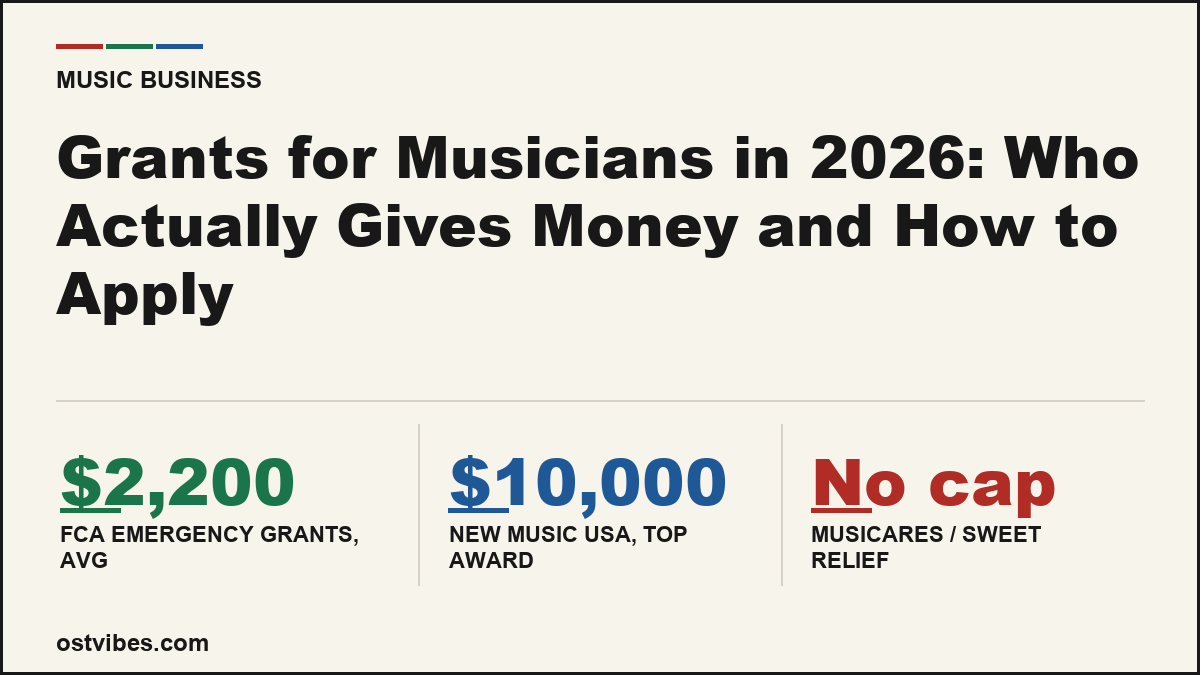
Real grant money for musicians in 2026 runs from a few hundred dollars to $50,000, no strings attached. MusiCares and Sweet Relief cover rent and medical bills with no published cap, any day of the year. Groups like the Foundation for Contemporary Arts and New Music USA pay $2,000 to $10,000 per project, and state arts councils write $5,000 to $8,000 checks straight to individual artists.
This guide lists active programs: what they pay, who qualifies, how to apply. Big names like New Music USA, the NEA, ASCAP, and BMI run once a year and already closed their 2026 windows. We flag what’s open now and what to bookmark for next year.
Grants for musicians in 2026 at a glance
Here’s the full list side by side. Programs marked “rolling” accept applications year-round; everything else runs on an annual cycle, and most 2026 windows had already closed as of this writing.
| Program | Amount | Best for | 2026 status |
|---|---|---|---|
| MusiCares | Confidential, case-by-case | Music pros, 5+ years in the industry (3 for disaster relief) | Rolling – apply anytime |
| Sweet Relief Musicians Fund | Confidential, case-by-case | Musicians facing illness, disability, or age-related hardship | Rolling – apply anytime |
| Jazz Foundation of America | Confidential, case-by-case | Jazz, blues, and roots musicians | Rolling – call or visit anytime |
| FCA Emergency Grants | $500-$3,000 (avg. $2,200) | Artists with a confirmed upcoming presentation | Rolling – apply 8-10 weeks ahead |
| New Music USA Creator Fund | Up to $5,000 (avg. $3,000); one $10,000 award | Individual music creators, 21+ | 2026 window closed Nov 21, 2025 |
| BMI Foundation Composer Awards | $20,000 typical total pool (2026: over $30,000) | Classical/concert composers under 28 | 2026 deadline closed Jan 15, 2026 |
| NYSCA/NYFA Artist Fellowship | $8,000 | Individual artists living in New York State | 2026 window closed Jan 27, 2026 |
| Mass Cultural Council Grants for Creative Individuals | $5,000 | Massachusetts-based creative individuals | 2026 window closed Oct 28, 2025 |
| Chicago Individual Artists Program | Up to $6,000 requested | Chicago resident artists, 18+ | 2026 deadline closed Jan 15, 2026 |
| Sphinx Medals of Excellence | $50,000 | Black and Latinx classical musicians, early career | Annual, 3 recipients per year |
| NEA Jazz Masters Fellowship | $25,000 (once per lifetime) | Jazz musicians, by nomination only | Annual, no application |
| FCA Grants to Artists | $45,000 | Artists across 5 fields, by nomination only | Annual, no application |
The fastest money: emergency funds that pay bills today
If you need cash this week, skip the competitive grants below. These three organizations exist for musicians in financial trouble, and none of them run on an annual deadline.
MusiCares
MusiCares, the Recording Academy’s charity, pays for rent, mortgage, utilities, medical and dental bills, insurance premiums, and funeral costs for people who work in music, according to MusiCares’ official help page. You need five years in the industry, or three years for disaster relief specifically, or credit on six or more released recordings or videos. MusiCares publishes no average grant size; every case is confidential and sized to need, with money usually paid straight to your landlord or hospital, not to you as cash. It has provided disaster relief to musicians in the US and Puerto Rico for more than three decades, including tens of millions of dollars in assistance during the COVID-19 pandemic alone and further support after hurricanes and the recent Los Angeles wildfires. Call 800-687-4227 or email [email protected].
Sweet Relief Musicians Fund
Sweet Relief helps career musicians and music-industry workers dealing with illness, disability, or age-related hardship. You generally need a performance history or credit on three widely released recordings, plus financial need; unless you’re retired, a serious medical condition limiting your work is also required. Apply through Sweet Relief’s online “Request Assistance” form. No dollar figure is published; awards are sized individually, and exceptions can be requested.
Jazz Foundation of America
The Jazz Foundation of America’s Musicians’ Emergency Fund handles roughly 7,000 cases a year, about 25 a day, for jazz, blues, and roots musicians, covering rent, eviction prevention, utilities, food, instrument repair or replacement, and medical accompaniment. There’s no online form or fixed amount: you call or visit the New York office directly, and eligible musicians typically hear back in two to three weeks. All casework stays confidential. For instrument theft or damage, musical instrument insurance can prevent needing emergency replacement money.
Grants for a specific project or performance
These programs fund something you’re about to do, not your monthly bills. Read the fine print first: several explicitly refuse to cover the exact expenses the emergency funds above exist for.
Foundation for Contemporary Arts Emergency Grants
Despite the name, FCA’s Emergency Grants aren’t a hardship fund. They pay $500 to $3,000 each, averaging $2,200, according to FCA’s program page. The money must connect to a confirmed public presentation of finished experimental work: artist fees, airfare, hotel, materials, shipping, fabrication. It will not cover rent, food, medical bills, a work in progress, a commercial gallery show, tuition, or a CD, album, or book. You must be US-based with a US Tax ID, an individual artist not enrolled in school, with a locked presentation date and a three-year wait after any previous award. Apply eight to ten weeks ahead through FCA’s online portal.
New Music USA Creator Fund
The New Music Creator Fund pays individual creators up to $5,000, averaging $3,000, per New Music USA’s program page. One applicant each cycle also wins the $10,000 Thea Musgrave Performer-Composer Collaboration Grant; the 2026 round gave out $216,500 across 13 states. You must be 21+, have three-plus years of professional experience, not be enrolled in a degree program, and list one to five collaborators. Geographic eligibility rotates by cycle, and New York applicants can only apply once every two years. The 2026 portal closed November 21, 2025; watch for the next window. A companion Organization Fund pays groups, not individuals, an average of $7,000 (max $10,000); its 2026 window also closed, in March.
Big honors you can’t apply for
A couple of the most prestigious awards in music never take a submission from the artist. Knowing this saves you from hunting for a form that doesn’t exist.
NEA Jazz Masters Fellowship
The NEA’s Jazz Masters Fellowship pays $25,000, and you can only receive it once in your lifetime. Recipients are chosen entirely through public nomination; there’s no form to fill out yourself. The 2026 class includes Patrice Rushen, Carmen Lundy, and Airto Moreira, plus Rhonda Hamilton, who received the A.B. Spellman NEA Jazz Masters Award for Jazz Advocacy. Nominating a deserving musician is the only way in.
Foundation for Contemporary Arts Grants to Artists
FCA’s other program, Grants to Artists, pays $45,000 per artist, unrestricted, no reporting required. The 2025 cohort split that money among 23 artists across five fields, including music and sound. FCA is direct about it: “applications and unsolicited nominations are not accepted.” A confidential panel of invited nominators proposes one artist each, in a two-stage process you cannot enter. Don’t search for an application that isn’t there.
Composer, songwriter, and genre-specific awards
ASCAP Foundation awards
The ASCAP Foundation runs several programs. Its Morton Gould Young Composer Awards, for concert-music composers ages 13 to 30, ran January 6 to February 6 in 2026 and named 17 primary winners plus 7 honorable mentions. We could not confirm a per-award dollar figure from any ASCAP source, so call before assuming an amount. The Leiber & Stoller Scholarship for Songwriters had a May 21, 2026 deadline. ASCAP also funds nonprofits running mentorship or songwriting-workshop programs, but that money is invitation-only, with a September 1 deadline. See our ASCAP vs. BMI vs. SESAC comparison when choosing a rights organization.
BMI Foundation awards
BMI Foundation’s Composer Awards fund classical and concert music with $20,000 in total awards a typical year. You must be under 28 and live in the US or its territories, or hold Western Hemisphere citizenship; the 2026 deadline was January 15, with an anonymized score plus audio rendering required. A gift from Pulitzer Prize-winning composer John Adams, along with other donors, pushed the 2026 pool past $30,000, over $10,000 more than in a typical year, so both figures can be accurate depending on the year cited. BMI also runs the peermusic Latin Music Award, a $5,000 scholarship for the best song in any Latin genre (ages 17-24, US or Puerto Rico), and the Pete Carpenter Fellowship, a paid mentorship residency for film, TV, and video-game composers that includes two $3,000 stipends, not an unpaid placement. Both closed June 30, 2026. Our soundtrack guides cover film scoring further.
Sphinx Medals of Excellence
The Sphinx Organization gives a $50,000 career grant, the Medal of Excellence, to three Black and Latinx classical musicians a year, chosen for artistic excellence and community leadership. The 2026 honorees, announced in March, were Nathan Amaral, Josh Jones, and Na’Zir McFadden.
State and city arts councils: where individual dollars actually flow
Here’s a detail that trips people up. The NEA’s main funding program, Grants for Arts Projects, pays $10,000 to $100,000, but only to organizations, according to the NEA’s own guidelines. Individual musicians and for-profits are ineligible, and qualifying nonprofits (five-plus years of programming, $20,000-plus in operating expenses) must match the grant dollar-for-dollar. Both FY2026 deadlines, in February and July, are closed.
So who pays individual musicians directly? Mostly state and city arts councils, often re-granting federal money through exactly this kind of partnership.
New York: NYSCA/NYFA Artist Fellowship
New York’s state arts council, NYSCA, funds the New York Foundation for the Arts to hand $8,000 unrestricted grants directly to individual artists in the state, according to NYFA’s program page. Non-winning finalists still get $1,000. The fellowship rotates across 15 disciplines on a three-year cycle. The 2026 window closed January 27, with notifications this summer.
Massachusetts Cultural Council Grants for Creative Individuals
Massachusetts pays $5,000 unrestricted grants to creative individuals in every discipline, music included. The FY2026 round gave 464 grants totaling $2.3 million; applications closed October 28, 2025, with awards announced in March 2026. The Council’s larger Artist Fellowships program only runs in odd-numbered years, so there’s nothing to apply for in 2026.
Chicago Individual Artists Program
Chicago’s Department of Cultural Affairs and Special Events lets local artists request up to $6,000 through its Individual Artists Program. The 2026 cycle gave over $1.3 million to 250 artists, from 1,239 applications, across disciplines including music, according to the city’s announcement. You need Chicago residency, must be 18 or older, able to treat the grant as taxable income, and not a full-time undergrad. The 2026 deadline was January 15; winners wait a year to reapply.
Nearly every state and most large cities run something similar. Search “[your state] arts council individual artist grant” to find yours. Expect $5,000 to $8,000, once a year, with a narrow application window.
How to actually apply and get picked
Grant panels read hundreds of submissions. A few habits separate the applications that get funded from the ones that don’t.
- Read the “what we don’t fund” section first. FCA Emergency Grants won’t touch rent or unfinished work, wasting your one shot.
- Apply to hardship funds before you’re desperate. MusiCares runs a full intake first; Jazz Foundation typically calls back in two to three weeks.
- Track eligibility windows, not just deadlines. Some programs take applicants from your region only once every two years, so one miss costs you two.
- Keep documentation ready year-round: proof of residency, a US Tax ID, recording credits, and a one-page budget for what the money covers.
- Time your application to when you qualify. BMI requires composers under 28; New Music USA requires three-plus years of experience.
- Don’t rely on grants alone. Pair them with steady income: Spotify’s per-stream payout is small alone, but sync licensing fees add up.
- Consider musician-specific financing too: a catalog loan advances cash against future royalties, and a music studio business loan can fund equipment instead of one project.
- Still studying? Most programs above exclude full-time students. Our music scholarships guide covers funding for that stage instead.
Frequently Asked Questions
How much money can a musician actually get from a grant?
It depends on the program. Emergency funds like MusiCares and Sweet Relief publish no number; awards are confidential and sized to need. Project grants land between $500 and $10,000: FCA’s Emergency Grants average $2,200, and New Music USA’s Creator Fund averages $3,000. The largest unrestricted awards, like FCA’s $45,000 Grants to Artists or Sphinx’s $50,000 Medal of Excellence, are chosen by nomination, not application.
Are music grants taxable income?
Most of them, yes. Chicago’s Individual Artists Program states that recipients must treat the funds as taxable income, and awards like the NYSCA/NYFA Fellowship work the same way: the money is yours, but it counts as income. Emergency assistance paid directly to a landlord or hospital may differ. Check with an accountant familiar with self-employed artists.
Can I apply if I don’t have any recordings out yet?
For most of these programs, not yet. MusiCares requires five years in the industry or credit on six released recordings. Sweet Relief wants credit on three released recordings or a performance history. New Music USA requires three-plus years of experience. These programs are built for working musicians with a track record. If you’re still building credits or in school, music scholarships fit better for now.
What should I do if I need money this week, not next year?
Go straight to the three rolling emergency funds. Call MusiCares at 800-687-4227 or email [email protected], fill out Sweet Relief’s Request Assistance form online, or call the Jazz Foundation of America if you play jazz, blues, or roots music. All three take requests year-round. Everything else here runs on an annual cycle, and most 2026 windows are already closed. Bookmark this page for when each reopens.
The bottom line
Grants for musicians are real money, but rarely fast money. MusiCares, Sweet Relief, and the Jazz Foundation of America take your call today if you’re in real financial trouble. Everything else here pays once a year at most, expects an existing track record, and often closes its window months before people think to look. Note when NYSCA/NYFA, New Music USA, ASCAP, and BMI typically open, and apply the moment each does. For more on funding a music career, visit our music business hub.

Riya has spent six years writing about music. At OST Vibes she covers soundtracks for film, series and games — who scored what, what is actually on each official release, and where to listen to it. Her focus is English-language pop and screen music. Spot a mistake in a tracklist or a credit? Email [email protected] and it will be corrected.