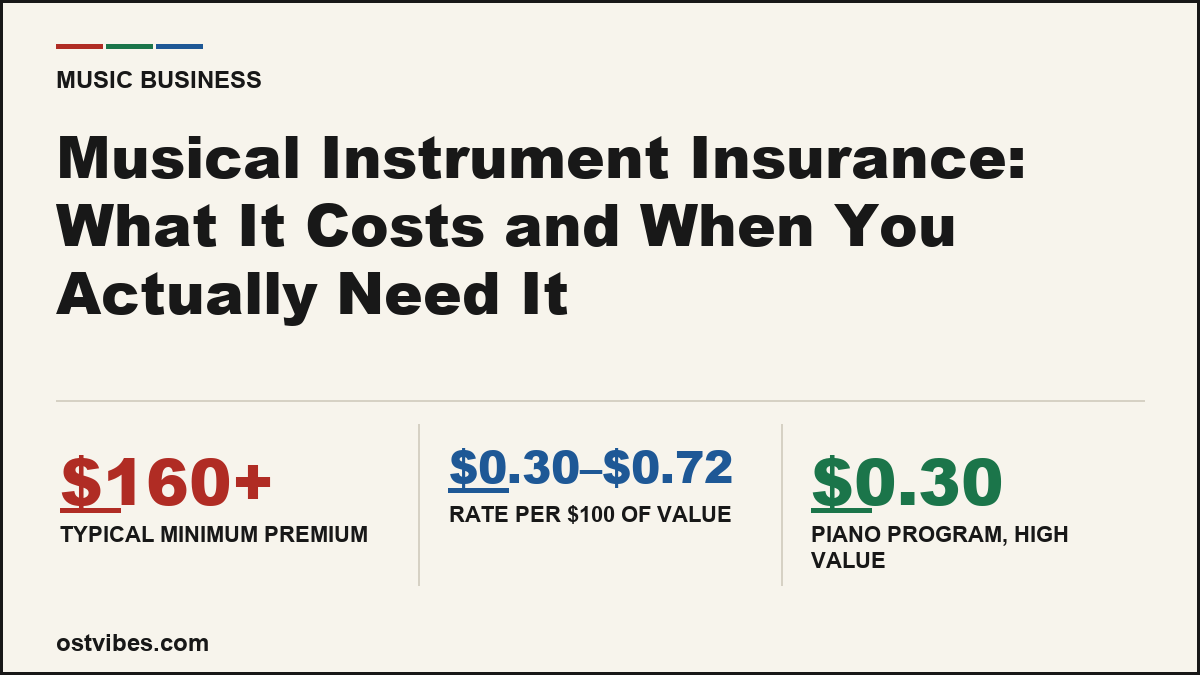
A dedicated musical instrument insurance policy usually starts at $160 to $260 a year in minimum premium, then scales up from there at roughly $0.30 to $0.72 per $100 of your instrument’s value, depending on the insurer and instrument type. Broader policies built for touring and gigging musicians, like the one from MusicPro, run closer to 1% of your gear’s total value per year. That’s the number most musicians want to know. The one nobody mentions upfront is what your homeowners or renters policy leaves out.
Standard home insurance caps business equipment at around $2,500 while it sits inside your house, and drops to about $250 once you carry it out the door. Worse, earning even a little money from an instrument — one paid gig, a couple of private students — can void that coverage entirely. The real question isn’t how expensive your violin or synthesizer is. It’s whether you get paid to play it.
What musical instrument insurance actually costs
Specialist insurers price coverage two ways: a rate per $100 of the instrument’s value, and a minimum annual premium that applies no matter how little your gear is worth. Here’s what the major providers publish.
| Provider | Program | Rate per $100 of value | Minimum annual premium | Deductible |
|---|---|---|---|---|
| Anderson Group | Signature (general instruments) | $0.64 | $175/year (includes $25 policy fee) | Varies by policy |
| Anderson Group | Piano program, up to $100,000 | $0.39 | $175/year | Varies by policy |
| Anderson Group | Piano program, $200,000+ | $0.30 | $175/year | Varies by policy |
| Anderson Group | Electronics add-on | $0.72 | — | Varies by policy |
| Anderson Group (National Flute Association program) | Member flute program | $0.50 | $160/year | None |
| Heritage Insurance Services | Players & Collectors (individual) | Not published | $200/year | None |
| Heritage Insurance Services | Business/dealer policies | Not published | $350/year | Waived on customer-instrument loss |
| MusicPro Insurance | Musician/equipment policy | About 1%+ of value per year (per VP on record) | Advertised “as low as” $175/year | From $100 per loss |
| Clarion Associates | All programs | Quote-only, not published | Quote-only, not published | Quote-only |
A few patterns hold across every insurer here. Minimums exist so a company isn’t writing a $14 policy for a $2,000 clarinet: expect at least $160 to $260 a year no matter how modest your gear is. Rates also differ by instrument type, since a piano’s per-$100 rate runs lower than a general instrument’s, pianos being heavier, harder to steal, and rarely dropped. One major provider, Clarion Associates, publishes none of this. More on why below.
If you’re funding new gear through grants for musicians rather than paying cash, keep in mind that grant money usually covers the purchase price, not the ongoing insurance premium. Budget for both from the start.
Why your homeowners or renters policy probably won’t cover your instrument
The coverage caps are lower than musicians assume
Most people assume an instrument is covered the same way a couch or a laptop is covered. It isn’t, not fully. The Insurance Information Institute puts the usual homeowners limit for business equipment at $2,500 while it’s at home, and just $250 once it leaves the house. Anderson Group, a specialist insurer, separately puts the typical instrument cap around $2,000, with off-premises coverage limited to about 10% of your personal property limit. Either way, a home policy was built to cover a television, not a $15,000 cello you carry to three gigs a week.
The business-use exclusion that catches gigging musicians
This is the exclusion that trips up more musicians than any dollar limit does. Anderson Group estimates that roughly 90% of homeowners policies exclude any business use of an instrument unless you’ve added a specific “pay-to-play” endorsement. Drop your guitar on the way to a paying gig, and the claim can be denied outright, not just reduced. Nationwide’s own guidance confirms the gap: standard policies cover only named perils like fire and theft, exclude flood entirely, and rarely extend to professional musicians because of the added risk.
That income doesn’t have to be substantial. A handful of paid gigs, private students, session work, or a sync placement (see our breakdown of how sync licensing works) can all count as business use. Ingram Insurance Group puts it plainly: even occasional income like that can void standard homeowners coverage for the item completely. Even musicians whose main income comes from streaming royalties rather than live shows can find an insurer treats the instrument as a business asset.
Depreciated payouts, and repair damage isn’t covered either
Even an approved claim often pays less than expected. Standard homeowners policies typically pay actual cash value, your instrument’s depreciated worth, not what it costs to replace today. They also miss a problem unique to instruments: repair devaluation. Anderson Group notes that if a violin bow breaks and is carefully repaired, its value can still drop by 25% to 50% or more, since a repaired instrument sells for less than an undamaged one. Standard policies also exclude wildfire, hurricane, flood, mudslide, and earthquake damage, perils a specialist policy usually covers as standard.
What a homeowners endorsement can (and can’t) fix
If your gear is inexpensive and you never get paid to play it, you may not need a separate policy. A homeowners or renters endorsement can close part of the gap for relatively little money.
A basic endorsement can raise business-equipment coverage from $2,500 to $5,000 for under $20 a year, with some insurers allowing increases up to $10,000 in $2,500 steps. Need more, and a broader “in-home business policy” provides up to $10,000 of business property coverage for under $300 a year, plus additional liability protection.
There’s also scheduling: naming your instrument specifically on your existing policy. NerdWallet notes that personal-property coverage typically runs 50% to 70% of your dwelling coverage, with categories like business-use items, electronics, and jewelry often carrying their own sub-limits. Scheduling an instrument pulls it out of that shared sub-limit and insures it on its own, often enough for a hobbyist with one valuable instrument and no gig income.
None of these fixes touch the business-use exclusion, though. Get paid to play, and you’re back to needing a dedicated policy.
The specialist insurers: Clarion, Heritage, Anderson, and MusicPro
Clarion Associates
Clarion is the oldest name in the category: a third-generation, family-owned agency with more than 50 years in business, insuring over 20,000 musicians and 30-plus major symphony orchestras. It underwrites the American Recorder Society’s member program, offering all-risk worldwide coverage and loaner-instrument coverage during repairs. But Clarion publishes no rates anywhere; every quote comes from a phone call to its 1-800-VIVALDI line or an online form.
Heritage Insurance Services
Heritage has insured instruments for more than 35 years, underwritten through Great American Insurance Group in a roughly 30-year partnership formalized in 2021. Heritage’s own site states that individual policies start at $200 a year and business policies at $350 a year. The individual Players & Collectors policy carries that $200 minimum with no deductible, though it excludes wear and tear, mold, vermin, confiscation, and war or insurrection.
For dealers, makers, and repair shops, Heritage’s “Workbench Policy” covers $20,000 per loss for faulty workmanship, including a subcontractor’s work, up to $15,000 a year for deferred-payment sales and instrument repossession, and $5,000 for preservation of property. The deductible is waived entirely when the loss involves a customer’s instrument rather than the shop’s own stock.
Anderson Group
Anderson publishes more pricing detail than any other insurer here. Founded in 1991 by Peter Anderson, a longtime member of the Boston Symphony Orchestra’s Tanglewood Festival Chorus, the company now covers more than 325,000 instruments across 39 countries for over 20,000 clients, with a 95% retention rate, and underwrites through Hanover Insurance, an A-rated carrier and one of the larger property-casualty insurers in the U.S.
Its Signature program charges $0.64 per $100 of insured value, with a $175 annual minimum including a $25 policy fee, enough to schedule roughly $23,400 in instruments for most types. Minimums shift by category: $225 for pedal harps, $185 for lever harps, $260 for string basses. Electronics riders run $0.72 per $100. Coverage includes worldwide all-risk protection, flood and earthquake, business use, diminished-value protection, up to $600 in performance-interruption reimbursement, and $100-a-month rental reimbursement for up to six months during repairs. Its piano program is tiered instead: $0.39 per $100 up to $100,000, $0.35 per $100 between $100,001 and $199,999, and $0.30 per $100 above $200,000, all under the same $175 minimum. Schedules over $100,000 qualify for preferred pricing, cutting the rate by 10% to 68%.
Anderson also underwrites affinity programs, including the National Flute Association’s member program, which charges $0.50 per $100 of value with a $160 annual minimum and no deductible, covering up to $27,000 in itemized instruments.
MusicPro Insurance
MusicPro was established in 2000 and is co-owned by ASCAP, one of the three major U.S. performing rights organizations alongside BMI and SESAC (see our comparison of ASCAP vs. BMI vs. SESAC), and SterlingRisk, a brokerage with more than 75 years in business. It now serves over 10,000 music professionals.
Its policies cover instruments, recording equipment, sound and lighting gear, and computer hardware and software, worldwide, with automatic coverage for newly acquired or borrowed gear up to $25,000 for the first 30 days. It’s advertised “as low as” $175 a year, with deductibles starting at $100 per loss rather than per item, and it excludes iPods, cell phones, and trailers.
On rate, MusicPro gives the most direct answer of any provider here. VP Program Manager Laura Donelan told Drumeo that pricing is based on the itemized total a client provides, and that “my rates are just a little over 1%, and yes that’s per year.” The costliest misconception, she added, is assuming gear is already covered under a homeowner’s or renter’s policy, when that coverage often lapses the moment equipment leaves the house or car.
Who genuinely needs specialist instrument insurance
Two thresholds decide this, and only one of them is about money.
The value threshold: Strings Magazine pegs roughly $5,000 in total instrument value, including bows, case, and accessories, as the point where dedicated coverage starts beating a homeowners rider. Below that, a scheduled endorsement is often enough. Above it, look for an insurer whose adjusters understand instrument-specific devaluation, like a soundpost crack, not a generic damage estimate.
The income threshold matters more. If you earn money playing, teaching, or recording on an instrument, most homeowners insurers treat it as business property once a claim comes in, regardless of whether the instrument cost $400 or $40,000. One paid wedding gig can be enough to trigger the exclusion under some policies.
- Working musicians who gig, teach, or record for pay
- Anyone who tours with an instrument or regularly ships one
- Owners of instruments worth more than roughly $5,000
- Dealers, luthiers, and repair shops, who need business coverage like Heritage’s Workbench Policy
- Orchestral, session, and touring musicians whose instrument doubles as their income-producing asset
Composers and session players scoring film and TV (see our soundtrack guides) usually fit this group by default, since their studio gear earns money on every paid project, not just occasional gigs.
Hobbyists who never get paid to play, own inexpensive gear, and keep it at home can usually skip specialist coverage. A homeowners endorsement or a scheduled rider covers the realistic risk for a fraction of the cost. If your only instrument is a $300 keyboard you never gig on, $175 a year in minimum premium buys you very little you didn’t already have.
One more trigger: financing. Buying gear through a business loan for your music studio rather than paying cash often means lenders require proof of insurance before releasing funds, making a specialist policy a condition of financing rather than an option.
Frequently Asked Questions
Does homeowners insurance cover a stolen instrument at all?
Often yes, up to a point. Theft is a covered named peril, but the payout caps around $2,500 at home and $250 off the property. Earn any income from the instrument, though, and the claim can still be denied under the business-use exclusion.
How much coverage do I actually need?
Insure the full replacement value, not the depreciated one, and include the case, bow, and accessories, since insurers price against that itemized figure. If you perform or teach for pay, also ask about business-use and liability add-ons; the base schedule alone won’t extend to income-generating activity on most policies.
What’s the cheapest way to insure a lower-value instrument?
If you’re under the roughly $5,000 threshold and don’t earn income from the instrument, a scheduled rider or a homeowners endorsement is usually cheaper than a standalone policy. Ask your carrier about endorsements that raise business-equipment limits to $5,000 for under $20 a year.
I only teach a few private lessons. Do I really need a separate policy?
Possibly, yes. Specialists in this category note that even occasional paid teaching can void a standard homeowners claim on the instrument used. Minimum premiums start around $160 to $200 a year, often cheaper than risking an uninsured instrument during a lesson.
The bottom line
Specialist musical instrument insurance costs $160 to $260 a year at the minimum, then scales with your gear’s value at $0.30 to $0.72 per $100 for scheduled programs like Anderson’s, or close to 1% a year for broader touring-musician policies like MusicPro’s. Homeowners and renters insurance, by comparison, typically caps out around $2,500 at home and $250 away from it, and stops covering your instrument the moment you start getting paid to play it.
If you gig, teach, record for pay, or own more than about $5,000 in gear, get quotes from Anderson, Heritage, MusicPro, and Clarion, and compare the numbers against your own instrument list. The annual cost usually lands close to what you’d spend on a single repair. If none of that applies to you, a homeowners endorsement is probably all you need. For more on the financial side of a music career, see our music business section.

Riya has spent six years writing about music. At OST Vibes she covers soundtracks for film, series and games — who scored what, what is actually on each official release, and where to listen to it. Her focus is English-language pop and screen music. Spot a mistake in a tracklist or a credit? Email [email protected] and it will be corrected.