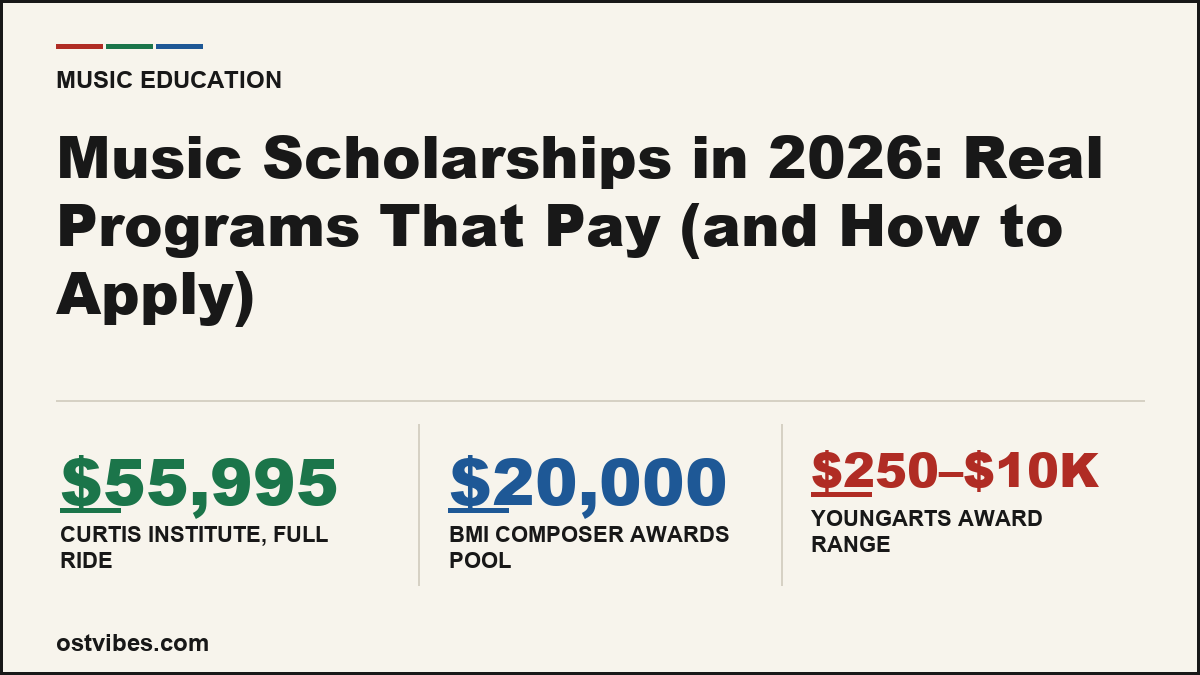
The biggest guaranteed music scholarship in 2026 isn’t a prize you enter and hope to win. Curtis Institute of Music gives every student it admits a full-tuition scholarship worth $55,995 a year for undergraduates and $69,527 for graduate students. There’s no separate application and no financial-need test. Getting in is the only requirement.
Below that sits a real set of programs that pay actual money: composer awards from BMI and ASCAP, a $250-to-$10,000 ladder at YoungArts, a $50,000 top prize at the Sphinx Competition, and merit money built into admission at schools like Berklee and Juilliard. This guide covers what each pays, who qualifies, and the 2026-27 deadline to hit — with links to each program’s own page, not a recycled scholarship list.
Music scholarships at a glance
Here’s the short version before the details. Entries marked “discretionary” mean the organization sets the dollar amount privately every year and doesn’t publish a fixed number in advance.
| Program | Pays | Who qualifies | Next deadline |
|---|---|---|---|
| BMI Student Composer Awards | $20,000 total pool, split among winners | Composers under 28 | Jan 15 (2026 window closed; annual cycle) |
| ASCAP Herb Alpert Young Jazz Composer Awards | Discretionary, not fixed | Jazz composers ages 13-30 | Dec 2, 2026 |
| ASCAP Morton Gould Young Composer Awards | Discretionary; 17 winners + 7 honorable mentions in 2026 | Composers of concert music ages 13-30 | Rotates yearly; check ascapfoundation.org |
| Curtis Institute of Music | Full tuition: $55,995 (undergrad) / $69,527 (grad) per year | Every admitted student | Dec 10, 2026 |
| YoungArts | $250 to $10,000 | Ages 15-18 or grades 10-12 | Oct 6, 2026 |
| MTNA Young Artist Performance Competitions | $5,000 top piano prize; $3,000 top strings/woodwinds prize | Ages 19-29 | Sept 9, 2026 (registration) |
| Sphinx Competition | $50,000 top senior prize down to $3,000 | Black and Latinx string players | Oct 20, 2026 |
| Your Future Is Now (Recording Academy x Amazon Music) | $10,000 per student, 5 students a year | HBCU students | Closed for 2026 (was May 8) |
| Quinn Coleman Memorial Scholarship | About $3,000 in stipends plus a paid internship | College students, 5 chosen a year | Not publicly dated; check grammy.com |
| Berklee Presidential Scholarship | Full cost of attendance (about $85,817 in value) | Top entering Berklee musicians | Automatic with your admission application |
| GRAMMY Music Educator Award (for teachers) | $10,000 winner / $1,000 finalists / $500 semifinalists | K-12 or college music teachers, not students | Closed (nomination Mar 15 / application Mar 31, 2026, for the 2027 award) |
BMI and ASCAP: cash awards for young composers
BMI Student Composer Awards
The BMI Foundation runs one of the oldest composer prizes around, and the $20,000 headline figure is easy to misread. According to BMI, it isn’t a per-winner check but a shared pool split across every winner that year, for classical works of any instrumentation.
To qualify, you must be under 28 as of February 15, 2026, and either live in the U.S. or its territories, or hold citizenship in a Western Hemisphere country. You can win at most twice, and the same piece can’t enter more than one BMI Foundation program. It runs on an annual January 15 deadline; 2026’s window already closed, so expect the next one around January 2027 — confirm on BMI’s page first.
If you’re also comparing BMI to ASCAP or SESAC for your own catalog, our comparison of the three performing rights organizations breaks down what each one pays songwriters.
ASCAP Foundation: Herb Alpert and Morton Gould awards
ASCAP runs two composer prizes through its Foundation, and neither publishes a fixed dollar amount. The ASCAP Foundation’s page for the Herb Alpert Young Jazz Composer Awards says the prize value is set at its sole discretion each year. It’s open to jazz composers ages 13 to 30 who are U.S. citizens, permanent residents, or hold a valid U.S. student visa. The 2026 recipients (announced March 31) were four Eastman School of Music students and alumni: Sam Chandler, Israel Stone, Rafael Enciso, and Denin Slage-Koch. The next window closes December 2, 2026.
The Morton Gould Young Composer Awards work the same way: no fixed figure, same 13-to-30 range, open to composers of concert music. The program has run since 1979, and its alumni include future Pulitzer Prize winners Jennifer Higdon, David Lang, Julia Wolfe, and Michael Abels. For 2026, the Foundation named 17 recipients plus 7 honorable mentions on June 10. An old “$40,000 total” figure still circulates for this award — ignore it; that traces to 2006 press coverage, not a current number.
Several past Herb Alpert and Morton Gould winners went on to score film and television. If that’s your direction, our soundtrack coverage is a good next stop.
Curtis Institute: the full-tuition model
Curtis Institute of Music has given every enrolled student a full-tuition, merit-based scholarship since 1928, according to Curtis’s financial aid page. There’s no separate application and no need-based test attached; admission alone qualifies you. For 2026-27, that scholarship holds at $55,995 for undergraduates and $69,527 for graduate students, renewed annually. Students needing help with rent, food, and other living costs can apply separately through the CSS Profile, a standard financial-aid form.
The trade-off: Curtis is extremely selective and the timeline is tight. Applications open in September and are due December 10, 2026. Live auditions run February through March in Philadelphia, and decisions go out April 1. Budget for a $150 nonrefundable application fee plus a $100 screening fee (required for most instruments); if you’re invited to a live audition, there’s an additional $150 audition fee, though the screening fee applies as a credit toward it. Curtis’s own page says applicants who complete a live audition should expect to pay $300 in total fees.
Curtis is one of several schools worth comparing. See our roundup of the best music colleges for how its full-tuition model stacks up against schools that charge full price and discount from there.
National performance competitions worth real money
YoungArts
YoungArts runs a national competition across ten disciplines: Classical Music, Jazz, Voice, Dance, Design, Film, Photography, Theater, Visual Arts, and Writing. Awards range from $250 to $10,000, according to YoungArts’ FAQ page. For the 2027 cycle, you need to be in grades 10-12, or 15 to 18 as of December 1, 2026, and a U.S. citizen or permanent resident, or otherwise eligible for taxable U.S. income. The fee is $35 per submission, with waivers available via a letter from a parent, teacher, counselor, or principal. The deadline is October 6, 2026, at 8 p.m. Eastern.
MTNA Young Artist Performance Competitions
The Music Teachers National Association runs a tiered competition up to National Finals. For 2026-27, the piano competition (sponsored by Steinway & Sons) pays $5,000, $1,500, and $750 for first through third, plus $100 merit awards; strings and woodwinds (MTNA Foundation Fund) pay $3,000, $1,500, and $750, also with $100 merit awards. A separate $1,000 Ebony Music, Inc. prize goes to the best piano performance of a work by a Black composer. Entrants must be 19 to 29 as of January 1, 2027. Registration closes September 9, 2026, and costs $135 per category; National Finals run April 2-6, 2027, in St. Louis.
Sphinx Competition
The Sphinx Competition is built for Black and Latinx classical string players — violin, viola, cello, bass. According to Sphinx’s competition page, the Senior Division (ages 18-30) pays $50,000 for first place (the Robert Frederick Smith Prize, plus orchestral solo engagements), $20,000 for second, $10,000 for third, and $5,000 for an audience choice award. The Junior Division (17 and under) pays $10,000 for first plus solo engagements, $5,000 for second, and $3,000 for third. Applications for the 2027 competition are due October 20, 2026, at 11:59 p.m. Eastern, through the Acceptd portal.
Scholarships built for specific communities (and one that’s not for students)
Your Future Is Now (Recording Academy x Amazon Music)
Now in its fifth year, this Recording Academy Black Music Collective and Amazon Music program awards $10,000 scholarships to five students at Historically Black Colleges and Universities (HBCUs), plus $10,000 equipment grants to two HBCU music programs, every year, according to the Recording Academy’s press release. Since 2021, it has given a cumulative $170,000 to 17 students and $80,000 in grants to 8 programs. The 2026 window closed May 8; watch for the next cycle to open in early 2027.
Quinn Coleman Memorial Scholarship
Established in 2021, this scholarship picks five college students a year. Each gets two $1,000 tuition scholarships, a $500 interview-prep stipend, and two $250 stipends for books or equipment — about $3,000 in direct stipends per person, plus a paid spring internship at the Recording Academy or Latin Recording Academy, arguably worth more than the cash long-term.
GRAMMY Music Educator Award: money for the teacher, not the student
This gets confused with student scholarships often: it actually pays a current, full-time K-12 or college music teacher, not a student. The winner gets a $10,000 honorarium, up to nine finalists get $1,000 each, and semifinalists get $500 — each paired with a matching grant to the teacher’s school, with no application fee. For the 2027 award — the next one to be presented, at Grammy Week 2027 — the nomination deadline was March 15, 2026, and the direct-application deadline was March 31, 2026; both have passed, but teachers can apply directly without a nomination once the next window opens.
Merit scholarships at conservatories and music schools
Berklee College of Music
Berklee automatically considers every entering undergrad and grad applicant for merit scholarships during standard admissions, with no separate form. The top award, the Presidential Scholarship, covers tuition, on-campus housing, a meal plan, a laptop or iPad, software bundles, and the comprehensive fee, renewable for up to eight semesters. Berklee’s own page says it goes to a “very limited number” of top entering musicians on audition strength and financial need, and fewer full-tuition-only awards go to other strong applicants. Berklee’s total 2026-27 cost of attendance is $85,817 — roughly what a Presidential Scholarship is worth in avoided costs.
Juilliard School
Juilliard’s tuition runs $55,500 a year. College Board’s BigFuture tool, which aggregates Juilliard-reported figures (Juilliard’s own aid pages weren’t accessible for verification here, so treat these as estimates), shows about 73.7% of students get some financial aid: an average $43,605 in need-based scholarships and an average $24,038 merit award.
The schools that won’t publish a number
USC’s Thornton School of Music and Indiana University’s Jacobs School of Music both run real, named merit scholarships, and neither publishes a dollar figure on its own dedicated financial-aid page. USC automatically considers first-year applicants who apply by December 1 for both Thornton music scholarships and USC’s Trustee (full-tuition), Presidential (half-tuition), and Dean’s (quarter-tuition) awards, no interview required. A $5,000-to-$15,000 range for roughly a third of admitted Thornton undergrads does appear on other USC-affiliated pages, so it isn’t purely a scholarship-blog invention — but treat it as a rough benchmark rather than a guaranteed figure, since Thornton’s own financial-aid page doesn’t state it. Indiana’s Jacobs School offers the Dean’s Scholarship, Premier Young Artist Award, Jacobs Scholar Award, and Presidential Scholars Award through automatic consideration at your audition, with amounts set case by case. If you’re still deciding whether a music degree is worth the debt it can carry, our piece on whether a music degree is worth it walks through the math.
How to actually apply and win
A few habits separate applicants who win from applicants who don’t.
- Apply to more than one program. A composer under 28 can reasonably enter BMI, both ASCAP awards, and YoungArts in the same year — they don’t conflict.
- Build a calendar around each program’s real cycle. Some close in January, some in September, some in December — miss one by a week and you wait a full year.
- Treat school-based scholarships as part of your admissions file. Berklee, Curtis, and USC fold merit money into the same application you use to get in, so a stronger audition tape does double duty.
- Prepare like the prize is the whole point. Our guide to the best music courses to advance your career covers where to sharpen technique before you record an audition or submit a score.
Frequently Asked Questions
Which of these deadlines are still open in 2026?
As of mid-2026, five deadlines are still ahead: MTNA registration (September 9), YoungArts (October 6), Sphinx (October 20), ASCAP’s Herb Alpert Young Jazz Composer Awards (December 2), and Curtis’s application deadline (December 10). The BMI Awards and Your Future Is Now have both closed for their 2026 cycles, and the GRAMMY Music Educator Award’s nomination and application windows for the 2027 award (the next one to be presented) also closed back in March 2026 — put all three on next year’s calendar.
Do I have to be a classical musician to win one of these?
No. The Herb Alpert Young Jazz Composer Awards are jazz-specific, and Sphinx and MTNA are built around classical string and instrumental performance, but YoungArts covers Voice and other genres broadly, and Berklee’s scholarships go to musicians across every style it teaches, from film scoring to contemporary performance.
Can international students apply for any of these?
It depends on the program. BMI requires U.S. or territory residency, or citizenship in any Western Hemisphere country — broader than a U.S.-only rule. The Herb Alpert Young Jazz Composer Awards require U.S. citizenship, permanent residency, or a valid U.S. student visa. YoungArts requires U.S. citizenship or permanent residency, or otherwise being eligible for taxable U.S. income. Check each program directly, since the rules vary.
What’s the difference between a “full-tuition” scholarship and a “full-ride”?
A full-tuition scholarship, like Curtis’s, covers instruction only — you still cover housing, food, and other living costs yourself. A full-ride, like Berklee’s Presidential Scholarship, covers tuition plus housing, a meal plan, and equipment like a laptop, which is why Berklee measures its value against the full $85,817 cost of attendance rather than tuition alone.
The bottom line
Real music scholarship money in 2026 ranges from a $250 YoungArts award to a $55,995-a-year tuition scholarship at Curtis to a $50,000 first prize at Sphinx. Every number here comes from the program’s own page or its own press release.
None of this replaces income once you’re out of school and releasing music on your own. At that point, it helps to understand how much Spotify actually pays per stream, how sync licensing turns one placement into ongoing income, and what funding looks like once scholarships are gone. Our music business section covers all three.

Riya has spent six years writing about music. At OST Vibes she covers soundtracks for film, series and games — who scored what, what is actually on each official release, and where to listen to it. Her focus is English-language pop and screen music. Spot a mistake in a tracklist or a credit? Email [email protected] and it will be corrected.