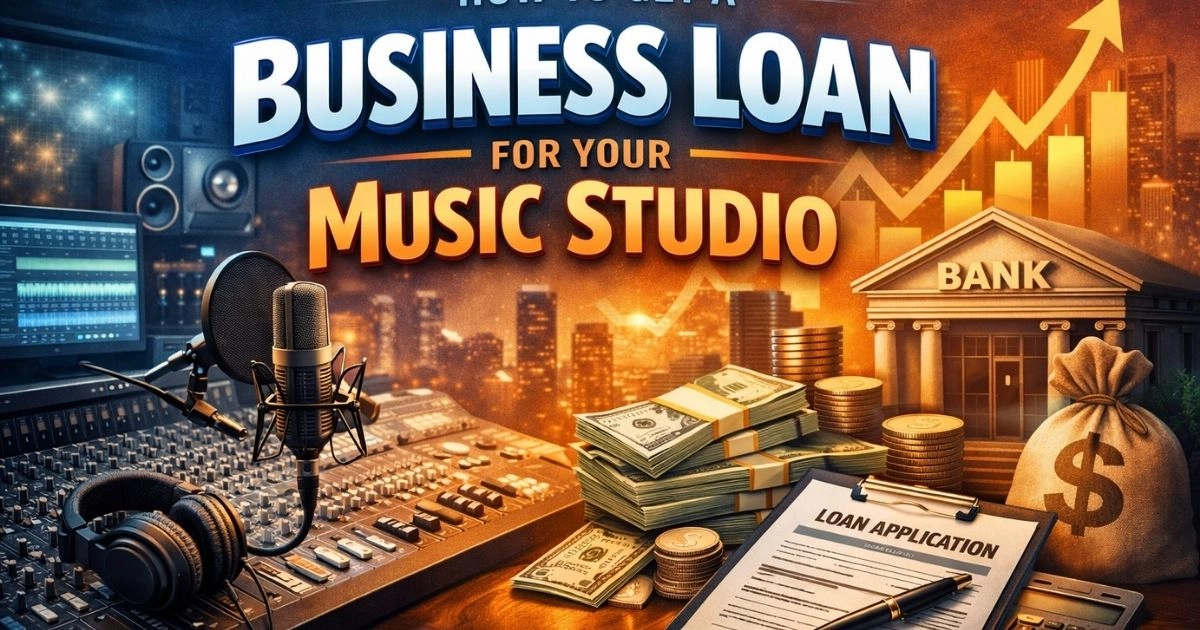
Dreaming of building the perfect recording studio — but your bank account isn’t quite keeping up with your vision? You’re not alone. From bedroom producers in Manchester to full-service recording houses in Nashville, one of the biggest obstacles facing music entrepreneurs worldwide is financing. Professional acoustic treatment, SSL consoles, Neve preamps, isolation booths, and top-tier monitoring systems don’t come cheap — and that’s before you factor in real estate, construction, and licensing costs.
The global music industry crossed $28.6 billion in revenue in 2023, and demand for professional studio space has never been higher — fueled by the rise of independent artists, podcast production, film scoring, content creation, and the explosion of streaming platforms. A well-run music studio is a legitimate, bankable business. And across the US, UK, Canada, Australia, and New Zealand, there are more funding options available to studio owners than most people realize. This guide walks you through every major financing route, country-by-country resources, qualification tips, and strategies to get your studio funded in 2025.
Music Studio Loan and Funding Options
| Funding Type | Typical Amount | Interest Rate | Repayment Term | Best For |
|---|---|---|---|---|
| Government-Backed Business Loans | $10,000 – $5M | 3% – 11% | Up to 25 years | Established studios with credit history |
| Equipment Financing / Leasing | $5,000 – $500,000 | 4% – 20% | 2 – 7 years | Buying consoles, monitors, mics, gear |
| Business Line of Credit | $10,000 – $250,000 | 7% – 25% | Revolving | Cash flow management, ongoing expenses |
| Commercial Real Estate Loan | $100,000 – $5M | 4% – 9% | 15 – 30 years | Buying studio building or property |
| Online / Alternative Lenders | $5,000 – $250,000 | 10% – 40% | 3 months – 5 years | Fast funding, lower credit requirements |
| Startup / Microloan Programs | $500 – $50,000 | 5% – 13% | 6 months – 6 years | New studios, early-stage entrepreneurs |
| Arts & Music Grants | $1,000 – $100,000 | None (free) | N/A | Independent artists, nonprofits, community studios |
| Crowdfunding | $1,000 – $500,000+ | None | N/A | Studios with an engaged fan base or community |
What Does It Actually Cost to Build a Music Studio?
Before you walk into any bank or click “apply” on any lending platform, you need a clear, honest picture of your budget. Costs vary by country and city, but here’s a universal breakdown by studio tier:
Home / Project Studio — $5,000 to $30,000 This covers a quality audio interface (like a Universal Audio Apollo or Focusrite Scarlett), studio reference monitors (Yamaha HS8, Adam Audio, or Genelec), a DAW license (Pro Tools, Logic Pro, Ableton Live), a solid microphone setup, and basic acoustic treatment panels. Ideal for independent producers, beat makers, podcasters, and singer-songwriters.
Mid-Level Professional Studio — $50,000 to $250,000 At this level, you’re investing in proper acoustic construction or room renovation, a professional mixing console, a diverse high-end microphone collection, outboard gear (compressors, EQs, reverb units), proper soundproofing, and a live room. This is the entry point for a commercially viable recording studio that can book paying clients consistently.
World-Class Commercial Studio — $500,000 to $5 million+ Think SSL or Neve consoles, purpose-built rooms with floating floors and isolated vocal booths, Augspurger or ATC monitoring systems, premium outboard processing, and top-tier everything. At this level, architectural fees, acoustic engineering, and real estate are major budget components.
Knowing your tier shapes everything — which loan products to target, how much to borrow, and how to frame your business plan.
Types of Loans Available for Music Studios
1. Government-Backed Small Business Loans
Every English-speaking country offers government-supported loan schemes designed to help small businesses — including creative industries — access affordable capital. These typically offer lower interest rates, longer terms, and more flexible eligibility than standard commercial loans.
United States — SBA Loans The U.S. Small Business Administration (SBA) offers some of the best financing available to studio owners. The SBA 7(a) loan can be used for equipment, real estate, construction, or working capital — with amounts up to $5 million, rates between 6–11%, and terms up to 25 years. The SBA Microloan (up to $50,000) is perfect for new studios or smaller builds, with more relaxed credit requirements. You’ll need a credit score of 650+, 2+ years in business (for 7a), and a solid business plan.
United Kingdom — British Business Bank The Start Up Loans programme offers personal loans of up to £25,000 at a fixed 6% interest rate, specifically for new businesses including creative ventures. Beyond the money, you also get free mentoring — invaluable for first-time studio owners. For growing studios, the Recovery Loan Scheme and various Innovate UK grants are worth exploring, particularly if your studio incorporates innovative music technology.
Canada — BDC and CSBFP The Business Development Bank of Canada (BDC) specializes in financing for small and medium businesses, with flexible terms and an understanding of creative industry cash flows. The Canada Small Business Financing Program (CSBFP) allows studios to borrow up to $1 million for equipment and leasehold improvements — with the government guaranteeing 85% of the loan, making lenders far more willing to approve applications.
Australia — Small Business Loan Guarantee Scheme The Australian federal government’s Small Business Loan Guarantee Scheme and state-level programs provide accessible financing for creative businesses. State arts bodies — Creative Victoria, Create NSW, Arts Queensland, artsACT, and Arts South Australia — also offer grants and low-interest loans specifically for arts and music enterprises.
New Zealand — Callaghan Innovation & NZTE New Zealand Trade and Enterprise (NZTE) and Callaghan Innovation offer funding and support for creative businesses with growth potential. The Regional Business Partner Network can also connect studio owners with grants and subsidized advisory services. New Zealand’s smaller market makes community relationships and arts council funding especially important.
2. Equipment Financing and Leasing
This is arguably the most studio-friendly loan type available worldwide. Equipment financing lets you borrow money specifically to purchase gear, using that equipment as collateral. Because the lender can repossess the gear if you default, approval requirements are more lenient — making it accessible even if your credit history isn’t perfect.
Common studio equipment that qualifies includes mixing consoles, studio monitors, audio interfaces, microphones and preamps, outboard gear, computers and DAW software, acoustic treatment materials, recording booths and isolation panels, and video production equipment if your studio doubles as a content studio.
Many equipment financing arrangements allow you to finance 100% of the purchase price with no down payment. Lease-to-own deals are also popular in the audio industry — you pay monthly, and at the end of the term, you own the gear outright. Major lenders offering equipment financing include Crest Capital and Balboa Capital (US), Fleximize and Nucleus Commercial Finance (UK), BDC Equipment Financing (Canada), and Earlypay and Moula (Australia).
3. Business Line of Credit
A business line of credit functions like a credit card — you’re approved for a maximum limit and only pay interest on what you actually use. For music studios, this is ideal for managing the unpredictable, seasonal nature of booking revenue. Slow months happen. A line of credit ensures you can cover rent, utilities, staff, and maintenance while waiting for sessions to pick back up.
Many studio owners use a line of credit alongside a term loan — the term loan covers major capital expenses (construction, big equipment purchases), while the line of credit handles day-to-day cash flow.
4. Commercial Real Estate Loans
If your long-term goal is to own your studio building rather than rent, a commercial real estate (CRE) loan is the route to take. These loans typically require a 20–30% down payment, strong financial documentation, and a proven business track record. In return, you get lower interest rates and the long-term financial benefit of building equity in a property.
Most successful studio owners start by leasing space, generating consistent revenue, and then using that financial history to qualify for a property purchase. Patience here pays off significantly.
5. Online and Alternative Lenders
When traditional banks say no — or when you need funding fast — online lenders fill the gap. Platforms like Kabbage, Bluevine, and OnDeck (US), iwoca and Funding Circle (UK), Swoop Funding (UK/Canada/Australia), and Prospa (Australia/NZ) offer fast approvals, minimal paperwork, and funding within 24–72 hours.
The tradeoff is higher interest rates, sometimes significantly so. These products are best used as short-term bridges — for example, you land a major corporate client and need to upgrade your vocal booth before the session — not as long-term financing strategies.
How to Qualify: What Lenders Look For Everywhere
Regardless of which country you’re applying in, lenders evaluate your application using broadly the same framework — often called the Five C’s of Credit:
Character refers to your credit history and personal reputation. A personal credit score of 650+ is generally the floor for most loans; 720+ opens access to the best rates and terms. Pay your bills on time, reduce existing debt, and resolve any collections before applying.
Capacity is your ability to repay. Lenders examine your revenue, existing debts, and projected income. If you’re a new studio without a track record, realistic financial projections backed by genuine market research become even more important.
Capital means how much of your own money you’re investing. Lenders in every country want to see you have skin in the game. Expect to contribute 10–30% of total project costs from your own funds.
Collateral refers to assets you can pledge against the loan — equipment, property, or even accounts receivable from confirmed bookings.
Conditions covers the purpose of the loan and the current business environment. A well-researched business plan that speaks to the music industry’s growth trends and your local market opportunity will meaningfully strengthen any application.
Building a Business Plan That Gets Approved
A professional business plan is the single most important document you’ll prepare when applying for a studio loan. Here’s what to include:
Executive Summary: A one-page overview of your studio concept, unique value proposition, target market, and financial goals. Write this last, but place it first.
Market Analysis: Research studio demand in your city or region. How many studios are operating nearby? What do they charge per hour? What’s the going rate for mixing, mastering, and production packages? Who are your ideal clients — independent musicians, podcasters, corporate video producers, film and TV composers?
Services and Revenue Streams: The strongest studio businesses don’t rely on a single income source. List all the ways your studio will generate revenue: hourly studio rental, music production packages, mixing and mastering services, podcast production, music lessons, session musician bookings, equipment rental, and licensing original beats or backing tracks.
Financial Projections: Provide three-year income statements, monthly cash flow projections for year one, and a clear break-even analysis. Be conservative — lenders have seen wildly optimistic projections before and will adjust for them anyway.
Team and Experience: Highlight your audio engineering credentials, music industry experience, any formal education (Berklee, BIMM, SAE Institute, AFTRS, etc.), and relevant business management background. If you have notable clients, sessions, or credits, include them.
Grants and Free Funding Sources by Country
United States: The Recording Academy’s MusiCares Foundation supports music professionals financially. The National Endowment for the Arts (NEA) funds music organizations and community studios. Many state arts councils — from the New York State Council on the Arts to the California Arts Council — offer additional grants.
United Kingdom: Arts Council England, Creative Scotland, Arts Council of Wales, and Arts Council of Northern Ireland all offer grants to music businesses and community studios. The PRS Foundation specifically supports music creators and organizations.
Canada: The Canada Council for the Arts and provincial arts councils (Ontario Arts Council, BC Arts Council, Alberta Foundation for the Arts, etc.) provide significant grant funding to music businesses and recording projects.
Australia: Australia Council for the Arts, APRA AMCOS, and state arts bodies offer grants for music production, studio development, and creative industry infrastructure. The Sound Australia program supports the recording industry specifically.
New Zealand: Creative New Zealand is the primary arts funding body and offers grants to music businesses, recording projects, and community studios. NZ On Air funds New Zealand music content creation, which can indirectly support studio revenue.
Global / Platform-Based: Kickstarter, Indiegogo, and GoFundMe have collectively funded dozens of successful studio projects worldwide. Offer backers studio time, production credits, exclusive merchandise, or naming rights to rooms in exchange for support. A well-run crowdfunding campaign also serves as proof of community demand — something lenders notice.
Smart Tips to Strengthen Your Application
Separate your finances immediately. Open a dedicated business bank account if you haven’t already. Mixing personal and business finances is one of the biggest red flags lenders see — it signals disorganization and makes your revenue harder to verify.
Get your documents ready before you apply. Gather two years of tax returns, six months of bank statements, and profit and loss statements. Having everything prepared upfront dramatically speeds up the approval process.
Get detailed quotes first. Before applying, obtain written quotes for all major equipment purchases and any construction or renovation work. Lenders want to see exactly where the money is going — vague estimates raise doubts.
Improve your credit score before applying. Even a 20–30 point improvement can move you into a better rate tier. Pay down credit card balances, ensure all accounts are current, and dispute any errors on your credit report.
Seek free guidance. In the US, SCORE mentors and Small Business Development Centers (SBDCs) offer free business planning support. In the UK, the British Business Bank’s Business Support Hub provides free resources. In Canada, BDC advisors offer free consultations. In Australia, Business Enterprise Centres (BECs) and AusIndustry advisors provide similar services. Use them.
Frequently Asked Questions (FAQs)
Q: Can I get a music studio loan with bad credit? A: Yes — your options are more limited and more expensive, but they exist. Equipment financing is your most accessible route since the gear serves as collateral. Online alternative lenders often work with credit scores as low as 580–600. The best long-term strategy is to work on improving your credit score before applying, as even modest improvements can significantly reduce your interest rate.
Q: How much can I borrow for a music studio? A: It depends on your loan type and financial profile. Equipment financing typically covers $5,000 to $500,000. Government-backed business loans can go up to $5 million. For most independent studios, loan amounts between $25,000 and $300,000 are most common. Your revenue, credit history, and collateral all influence the maximum amount available to you.
Q: Do I need a business plan to apply for a studio loan? A: For government-backed loans, SBA loans, and most bank loans — yes, absolutely. Even for equipment financing and online lenders, a clear written plan demonstrates professionalism and can help you negotiate better terms. It also forces you to think through your revenue model before you commit to debt.
Q: Can I use a personal loan to fund a music studio? A: Technically yes, but it’s generally not recommended. Personal loans carry higher interest rates, lower borrowing limits, and don’t help you build business credit. For home studio builds under $20,000, a personal loan can be a quick and simple bridge. For anything larger, a proper business loan is a significantly better financial decision.
Q: How long does loan approval take? A: Online/alternative lenders can approve and fund in 24–72 hours. Traditional bank loans take 2–4 weeks. Government-backed loans like SBA, BDC, and CSBFP loans typically take 4–8 weeks. Start your applications early, especially if you have lease-signing deadlines or equipment availability windows to work around.
Q: Is a music studio actually a profitable business? A: Absolutely — when managed strategically. Studios that rely solely on hourly room rental often struggle to reach profitability. The most successful studios diversify their revenue: production services, mixing and mastering, podcast production, content creation, music lessons, equipment rental, and original music licensing. Location, reputation, and smart marketing are the other major factors separating thriving studios from struggling ones.
Q: What equipment should I prioritize when borrowing? A: Start with the tools that directly generate revenue and that clients are actually paying for: a professional audio interface, accurate studio monitors, a reliable DAW setup, a quality large-diaphragm condenser microphone, and proper acoustic treatment. These fundamentals build your foundation. Premium consoles, outboard gear, and specialty microphones are phase two investments — once your revenue supports them.
Q: Are there lenders that specialize in music or creative industry loans? A: While few lenders focus exclusively on musicians, many have experience with creative businesses. In the US, community development financial institutions (CDFIs) often understand creative cash flows better than large commercial banks. In the UK, Triodos Bank and Unity Trust Bank specifically focus on values-led businesses including arts organizations. In Canada, BDC has extensive experience with creative enterprises. Arts-focused credit unions in each country are also worth exploring.
Q: Should I lease or buy studio equipment? A: Leasing preserves cash flow and lets you upgrade equipment more frequently — important in a fast-moving industry where technology evolves quickly. Buying builds long-term equity and eliminates monthly payments once the loan is repaid. Many studio owners lease core everyday items (computers, software subscriptions) and buy mission-critical gear (consoles, monitors, outboard units) that holds its value well.
Disclaimer: This article is for informational purposes only and does not constitute financial, legal, or investment advice. Loan availability, interest rates, and program details vary by country, lender, and individual circumstances. Always consult a qualified financial advisor or accountant before making significant financial decisions for your business.

Riya has spent six years writing about music. At OST Vibes she covers soundtracks for film, series and games — who scored what, what is actually on each official release, and where to listen to it. Her focus is English-language pop and screen music. Spot a mistake in a tracklist or a credit? Email [email protected] and it will be corrected.